







At community events such as street festivals, parades, farmers markets, marathons, or outdoor concerts, physical barriers can serve very different purposes. Some create a visible route, separate pedestrian streams, or keep people away from an operational area. Others are engineered to resist a vehicle attempting to enter a protected space. From a distance, both may look like part of the same perimeter, but barrier functions are not interchangeable.
Application distinction matters because a well organized crowd is not necessarily a protected crowd. If vehicles can approach a pedestrian area, planners need to evaluate the potential for both accidental entry and deliberate vehicle ramming, then determine where channelization is sufficient and where hostile vehicle mitigation is required. The strongest layouts treat those needs as related parts of the same site plan rather than assuming one barrier type can solve both.
Separate Crowd Guidance from Vehicle Protection
Crowd control equipment is primarily meant to influence movement. Cones, retractable bars, lightweight pedestrian walls, and similar devices can define entrances, create queues, establish walkways, or separate spectators from operational areas. Their value comes from making the intended path obvious and maintaining orderly movement through a busy site. Hostile vehicle mitigation addresses a different hazard and is intended to prevent or limit vehicle penetration into areas occupied by pedestrians. The protection objective may be to stop an approaching vehicle, control access at a roadway entrance, or create a stronger physical boundary between traffic and a dense crowd.
A lightweight wall may provide effective pedestrian guidance and still offer no meaningful resistance to a vehicle entering at speed. Even water filled channelizing devices have to be understood according to their tested function and impact conditions. A barrier that can redirect a vehicle striking it from the side may not be designed to stop one traveling more directly toward it. Selection therefore begins with the hazard to be controlled, not simply the appearance or convenience of the barrier.
Start with the Vehicle Path
Before planners choose equipment, they need to understand how a vehicle could reach the crowd. The obvious entrance is only one part of that question. Adjacent roadways, parking areas, medians, sidewalks, greenbelts, service lanes, and other traversable spaces can create alternate approaches that are easy to overlook when attention is concentrated on the main gate.
Site teams should consider the type and mass of a credible vehicle, the distance available for acceleration, likely direction of travel, and the maximum speed that could realistically be reached before contact with the protective line. Existing features such as buildings, grade changes, permanent bollards, or other physical restrictions may already reduce some approach paths and can be incorporated into the plan.
CISA’s Vehicle Ramming Self-Assessment Tool supports this risk-based approach by helping users evaluate areas of interest, identify vulnerabilities and prioritize mitigation options. The broader goal should be to identify where a vehicle threat is credible, what consequence an intrusion could have, and what level of protection is appropriate before equipment is specified.
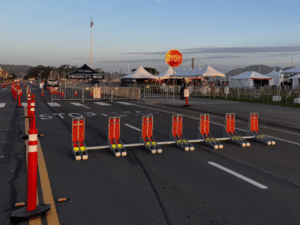
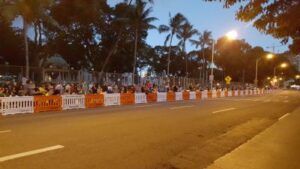
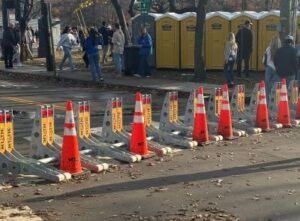
Images Courtesy of: TraFix Devices
Protect Access as Carefully as the Perimeter
A secure perimeter still must function as part of a live event. Thousands of people may need to enter and leave, vendors may require access before opening, and police, fire, or medical vehicles may need a route through the protective boundary. A layout that stops vehicles but produces a pedestrian bottleneck or blocks emergency response creates a different safety problem.
This makes spacing and configuration as important as barrier strength. Openings should preserve pedestrian throughput without creating a direct vehicle path into the crowd. They should also maintain accessible routes for people using wheelchairs, strollers and other mobility devices, rather than shifting the access problem elsewhere in the site plan. On wider roadways, overlapping or offset barriers can create a chicane that interrupts a straight vehicle approach while still allowing people to pass between protected points. For a multilane approach, planners can configure overlapping modules across the roadway so the layout disrupts a direct vehicle path while preserving designated pedestrian passage between protected points. At narrower entrances, the challenge may be providing strong vehicle resistance within limited sidewalk or streetscape space.
Visibility should also be taken into account. Highly visible equipment gives an inattentive or confused driver more opportunity to recognize a closure and correct course before reaching it. Stability keeps the device where the plan expects it to remain, while modularity can make temporary systems easier to configure around changing road widths, access points, and event footprints. These characteristics do not replace impact performance, but they influence how effectively a system functions in the conditions surrounding it.
Match the Device to the Job
Once planners determine where pedestrian guidance is sufficient and where vehicle intrusion presents a greater risk, they can begin matching each part of the site with equipment designed for that specific function. TrafFix Devices manufactures solutions across both categories, from lightweight systems that organize pedestrian movement to heavier barriers engineered for vehicle related hazards.
Its Urbanite pedestrian wall, for example, links into continuous six-foot sections to create defined walkways and crowd- control boundaries. At 23 pounds per section, it can be repositioned relatively easily as a site layout changes. The company’s Water-Wall provides a heavier modular boundary for longitudinal channelization applications. Its performance depends on the direction and angle of vehicle impact: in shallow-angle impacts, it can redirect a vehicle while undergoing controlled lateral deflection, but it is not intended to serve as a dedicated hostile vehicle mitigation system for a direct or deeper-angle approach into a pedestrian area. Water-Wall therefore should not be treated as a substitute for a purpose-designed vehicle mitigation system where preventing access into a pedestrian zone is the primary concern.
The TrafFix Sentry Water-Cable Barrier adds another level of longitudinal barrier protection. MASH crash tested at TL-3, 62.5 mph (100 km/h) the Sentry is an alternative to concrete barriers offering vehicle containment capabilities in security traffic zones. The Sentry is also tested and approved at ASTM 2656-15 MP40 P2 rating as listed on the Department of Defense Anti-Ram Vehicle Barrier List as a perimeter barrier.
For HVM applications, the protection level and operating requirements change. TrafFix’s Block Axess is a modular portable system certified to ASTM F2656 U30/P3 for a 7.5-ton vehicle impact at 30 mph. As with any crash-rated barrier, planners should review the complete test designation, expected penetration distance, layout and required standoff before selecting a system. The system can be assembled by one person in about 14 minutes, allowing a temporary event perimeter to incorporate tested vehicle-impact performance without requiring a permanent installation.
Controlled access points introduce another design challenge as a perimeter may need to stop unauthorized vehicles without permanently blocking the route. Temporary or semi-permanent systems can address that need by allowing an access point to remain protected during normal operation while still opening for emergency, service, or other authorized vehicles. In tighter spaces, planners also need to consider how vehicle protection will coexist with pedestrian movement, particularly along sidewalks, greenbelts, and other areas where available width is limited. TrafFix’s Vigi Blax and Vigi Blax Compact are examples of systems designed around these different access and space constraints. Vigi Blax is available in above-ground and in-ground configurations for controlled vehicle access, while Vigi Blax Compact is designed for constrained locations, such as sidewalks and greenbelts, where pedestrian movement must remain part of the site design. Both can support emergency-access planning when the operating procedures and site layout are established in advance.
For event planners, site managers and security teams, the objective is not to build the most restrictive perimeter possible, but to create one that responds precisely to the risks present at each part of the site. Areas with credible vehicle approach paths may require dedicated mitigation systems, while locations intended primarily to organize pedestrian movement can often rely on lighter channelizing devices. Treating those functions separately helps planners avoid overbuilding low risk areas while leaving more exposed access points inadequately protected.
Build Security in Layers
Large public events rarely benefit from a single defensive line. Consider a downtown street festival with vendor load-in, multiple pedestrian entrances and a multilane vehicle approach at the main closure. Lightweight channelizing devices may be appropriate for internal queues and circulation, while the most exposed roadway approach may require a dedicated HVM layout designed to disrupt a direct vehicle path. The same plan must also identify how emergency vehicles and authorized vendors will enter, who is permitted to open an access point and how that point will be secured again.
A stronger plan uses multiple layers to reduce vehicle speed, control access, protect exposed approaches, and manage pedestrian circulation within the secure area. Road closures and traffic management can form an outer layer while crash-rated barriers and controlled access points can protect the perimeter. Meanwhile, personnel, screening, monitoring, and asset specific measures can strengthen the interior.
These layers are only effective if they can be deployed, operated and restored to their intended protective position as planned. Many factors, including installation time, ground conditions, utility conflicts, staffing, setup schedules, removal, storage and reusability, influence whether a security plan will work in practice. Pedestrian, accessible and emergency access should also be evaluated after equipment is placed, rather than assumed from a drawing, because even a well-protected perimeter can create new problems if it restricts movement, evacuation or emergency response.
This last point is why final barrier layouts should grow out of a site specific assessment rather than a standard template. Every venue presents a different combination of road geometry, crowd density, operating requirements, and vehicle exposure. Resources from CISA can help planners identify and evaluate those risks, while manufacturers and security specialists can help translate the findings into equipment with appropriate tested performance and deployment characteristics. TrafFix Devices works with event planners, local law enforcement and security leaders to evaluate site conditions, map vehicle approach paths and identify equipment configurations that align with each location’s protection and operational requirements. For event planners, site managers, and security teams, your safety objective is not to build the most restrictive perimeter possible, but rather to create one that responds precisely to the risks present at each part of the site.
The right question is not simply what barrier belongs at an entrance. It is what vehicle path is credible at that location, what level of protection is needed and how pedestrians, emergency responders and authorized vehicles will move once the perimeter is in place. When those questions are answered together, event planners can create a perimeter that remains workable for the public while addressing the vehicle risks it is intended to manage.




