









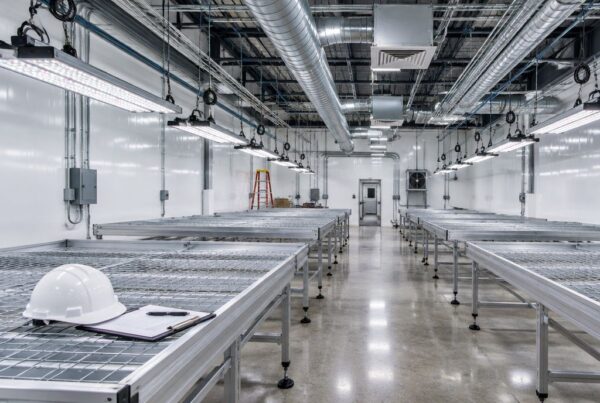
Cannabis has quietly become one of the more demanding clients in commercial construction. A production facility is part farm, part food plant, and part pharmaceutical cleanroom, and the builders who win this work are the ones who understand where those three worlds collide. For contractors eyeing the sector, here is what the work actually involves.
Climate is the building
Nothing in a cultivation facility matters more than environmental control. A single flowering room can carry plant transpiration loads that would swamp a standard commercial HVAC design, and the tolerance for drift is small: a few degrees or a humidity swing at the wrong stage can cost a grower an entire cycle. That means dedicated air handling per room rather than shared systems, dehumidification sized to the crop rather than the square footage, and redundancy, because a failed unit on a long weekend is not an inconvenience, it is a loss event.
The electrical story is similar. Lighting, climate systems, and processing equipment stack up to power densities closer to a data center than a warehouse. Early utility coordination is routine on these builds, and service upgrades are common. Water follows the same logic: cultivation is a high-demand, high-drainage use, and floor drainage, backflow protection, and water treatment all belong in the design conversation from day one.
Rooms with different jobs
A production facility is not one big grow room. Propagation, vegetative growth, flowering, drying, curing, trimming, and packaging each want their own environmental setpoints and their own workflow position, and the walls between them do real work. Washable surfaces, sealed penetrations, and pressure relationships between rooms are standard asks, borrowed directly from food-grade construction.
Processing raises the bar again. Producers that make concentrates need space for cold processing, and the modern solventless methods bring unusual requirements: wash rooms plumbed for large volumes of cold water, freeze-drying equipment with its own power and ventilation needs, and press rooms where temperature stability affects the product directly. Builders who have fitted out commercial kitchens or small food plants will recognize most of the details; the combination is what is new.
The vertical integration build
The most ambitious projects in the sector are vertically integrated: cultivation, processing, and fulfillment under one roof. British Columbia producer Vancity Labs runs on this model, growing its flower and producing its full product line in the same operation, from flower through concentrates such as live hash rosin, which requires exactly the kind of wash, freeze-dry, and press infrastructure described above.
For a builder, an integrated facility is a more complex program: agricultural, industrial, and distribution uses sharing walls, each with its own mechanical profile. But it is also where the sector is heading, because integration gives producers control over quality and margin, and the facility is what makes that control physical. The companies investing in these builds tend to be the ones planning to stay.
Retrofit or new build
Most cannabis facilities in North America are retrofits, usually of warehouses or light industrial space, and the retrofit math is deceptive. The shell is cheap; the conversion is not. Power service, roof penetrations for exhaust, floor drainage cut into slab, and vapor barriers behind every wall surface add up quickly, and ceiling height that looked generous shrinks fast once ductwork and lighting are hung. New builds flip the equation: higher entry cost, but mechanical systems designed rather than squeezed in, and expansion planned instead of improvised.
Retailers face a version of the same choices at smaller scale, as CCR covered in its look at Giving Tree Dispensary’s growth strategy, and the throughline holds across the sector: the companies that treat their physical plant as a competitive asset outperform the ones that treat it as overhead.
What builders should take from this
Cannabis construction rewards the same contractors who do well in food processing and controlled-environment agriculture: the ones comfortable with heavy mechanical scopes, tight environmental specs, and clients whose product lives or dies on building performance. The sector’s awkward adolescence is ending, and the producers still standing are investing in facilities built to last. For the construction industry, that is the signal worth noticing.
Feature Image: Courtesy of Vancity Labs






