








In numerous regions nationwide, adapting vacant office buildings as high-quality research laboratories is emerging as a growing and critical force in sustainable, money-making reuse. While a recent CBRE report shows increased vacancy rates in nine major research hubs nationally, several smaller markets are moving the other way. Places like Princeton and Mercer County, N.J., have robust demand — and even shortages — of lab and R&D offerings, bucking the national trend.
Still, experts like CBRE are bullish on life sciences demand generally, aligning with Deloitte’s recent survey showing high confidence among over 75% of medtech and biopharma executives. Another, JLL, sees growing demand for facilities supporting select areas of research, and many show wet labs earning premium rental values, especially when combined with office spaces or light manufacturing, or both. In the hotter regional markets, reports design firms like JZA+D, conversions and speculative developments (spec labs), built for general purpose research, are in demand now.
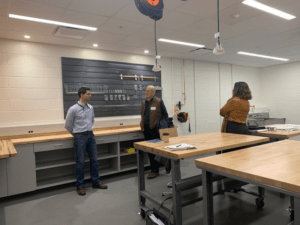
Image Courtesy of: JZA+D
JZA+D architect Mark A. Sullivan in Princeton, who designs laboratory environments for universities and corporations, sees these market forces “opening doors to opportunity for owners of fund performing assets.”

Image Courtesy of: JZA+D
“In Mercer County, where we’re based, the density of research activity and life sciences entrepreneurship, along with major research universities, form a high-energy cluster centered on Princeton,” says Sullivan. “Top players here report high vacancy rates in older office buildings, many with good locations and robust building systems, making them ideal for conversion to biotech and other lab uses.”
What’s Driving Conversions
Einstein’s Alley is one of many examples, says Sullivan, adding that this economic development group is boosting research organizations and related business enterprises around Central New Jersey. “They’re attracting both startups and established corporate and institutional research enterprises by promoting the talented workforce here, our major transportation corridors, and the proximity of manufacturing and key universities,” says Sullivan. “Though there are many hospitals, startups, and established biotech and pharma companies regionally, many can’t find leasable facilities that suit their needs.”
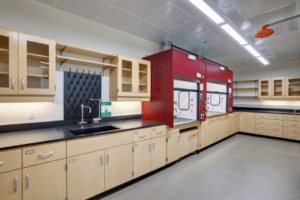
Image Courtesy of: JZA+D
Sullivan counsels property owners on building features and amenities to prime leasing and boost per-square-foot rental values. Some are evaluating and converting existing assets, while many R&D-driven enterprises are looking to expand. Candidate properties for conversions are surprisingly plentiful, according to JZA+D, and Sullivan and his team at JZA+D highlight the key qualities of successful conversion contenders:
- Flexibility. Assess the building structure and envelope to determine options for subdividing that will accommodate varied lease sizes and uses, and to allow adaptations for lab program requirements and equipment types.
- Circulation options. Cutting new corridors, stairs, and elevator shafts can be time-consuming and expensive, making it hard to hit project targets. Evaluate the existing building’s circulation areas and shared spaces to ensure the conversion is focused on labs, not interstitial zones.
- Infrastructure. As with circulation, existing capacity for HVAC, fresh air, daylight and other utilities should be benchmarked against quality laboratory infrastructure. This also means having robust electrical, water, gas, and sewer support in place, with the ability to add and access localized utility systems such as industrial, medical and specialty gases and related equipment.
A workable existing layout can propel project success. One property Sullivan recently analyzed had been purpose-built for a specific lessee and located its elevator shaft, counterintuitively, at one end, as far as possible from the long building’s loading dock.
The Spec Labs Proposition
Other office building types lend themselves more readily to conversion to spec labs, says Sullivan, research facilities developed specifically to draw tenants after or even during a phased construction process. Many well-suited properties near research hubs are ideal for this “build-first, lease-later” type of opportunity.
“Ideally, these conversion candidates meet all the criteria for infrastructure, circulation, flexibility, and most important, location,” he says, with reasonable proximity to an active research hub. With rental values significantly higher for adapted buildings that support life sciences and biopharma activity, conversions hold great promise for a healthy ROI in today’s science hub markets.
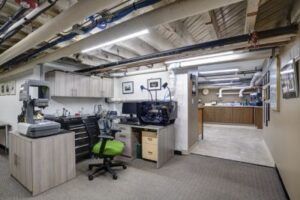
Image Courtesy of: JZD+D
For other longshot opportunities, Sullivan urges owners to consider less construction-intensive options such as converting offices to dry labs for research not involving chemical, biological and medical materials: robotics, electronics, computational modeling, and theoretical physics, among others. Dry labs may be simple studios or robust maker-space facilities, depending on the equipment involved, says Sullivan.
While no two office parks or commercial buildings are alike, one thing is certain: In the nation’s life sciences clusters, the push to convert to lab workplaces is driving a growing investment niche.






