










Data centers have become the backbone of the modern economy, powering everything from online retail and streaming to artificial intelligence and financial services. Their footprint is expanding rapidly: U.S. data center demand is projected to grow at double-digit rates through the decade, with facilities getting larger and more complex.
Yet, while these projects are celebrated for their technological sophistication, a critical issue often gets overlooked—the sheer volume of construction waste they generate.
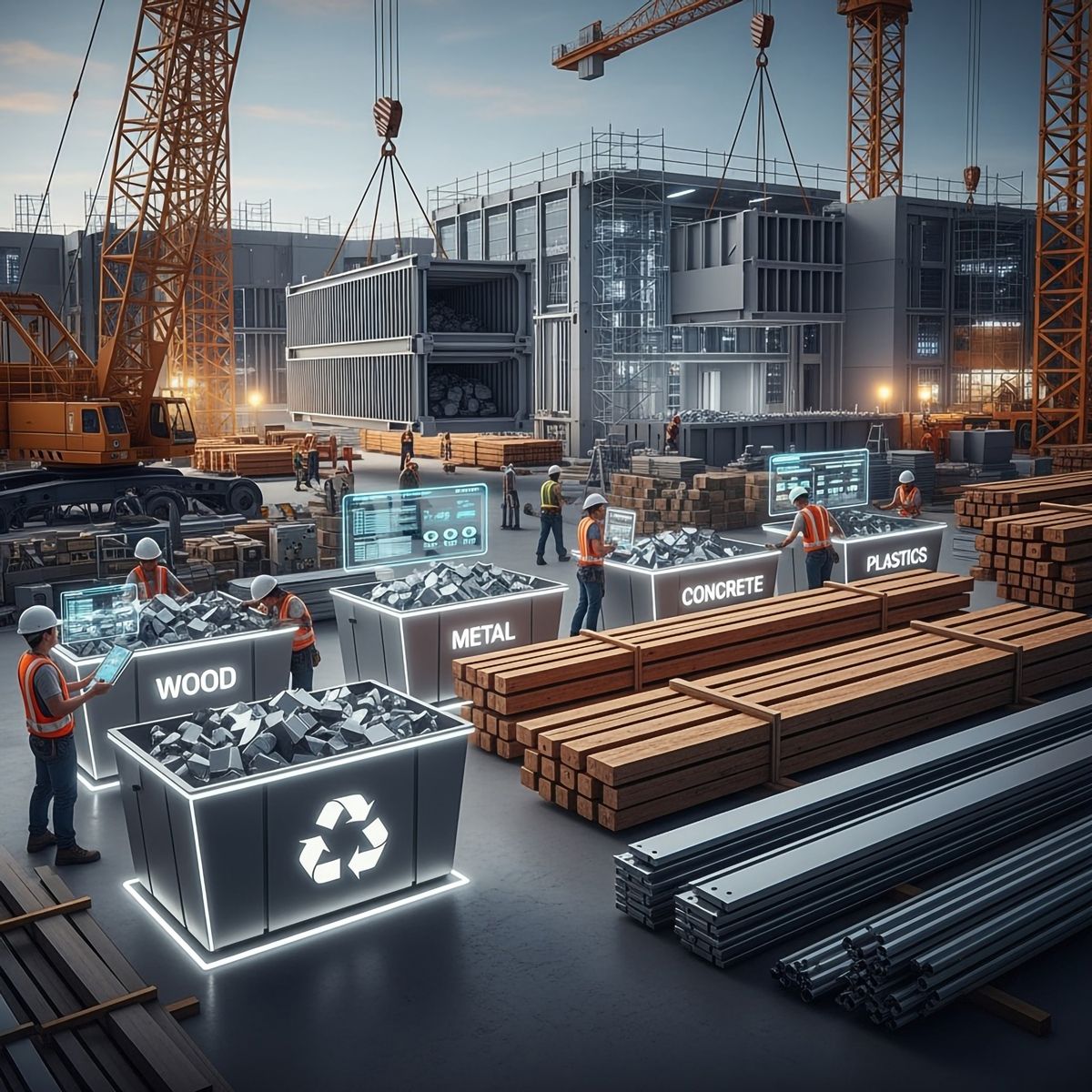
Bringing a single hyperscale facility online requires enormous amounts of concrete, steel, wood, plastics, and packaging. That scale translates into equally massive waste streams, much of which traditionally ends up in landfills. For an industry that champions sustainability and efficiency, this reality presents both a reputational challenge and a missed opportunity.
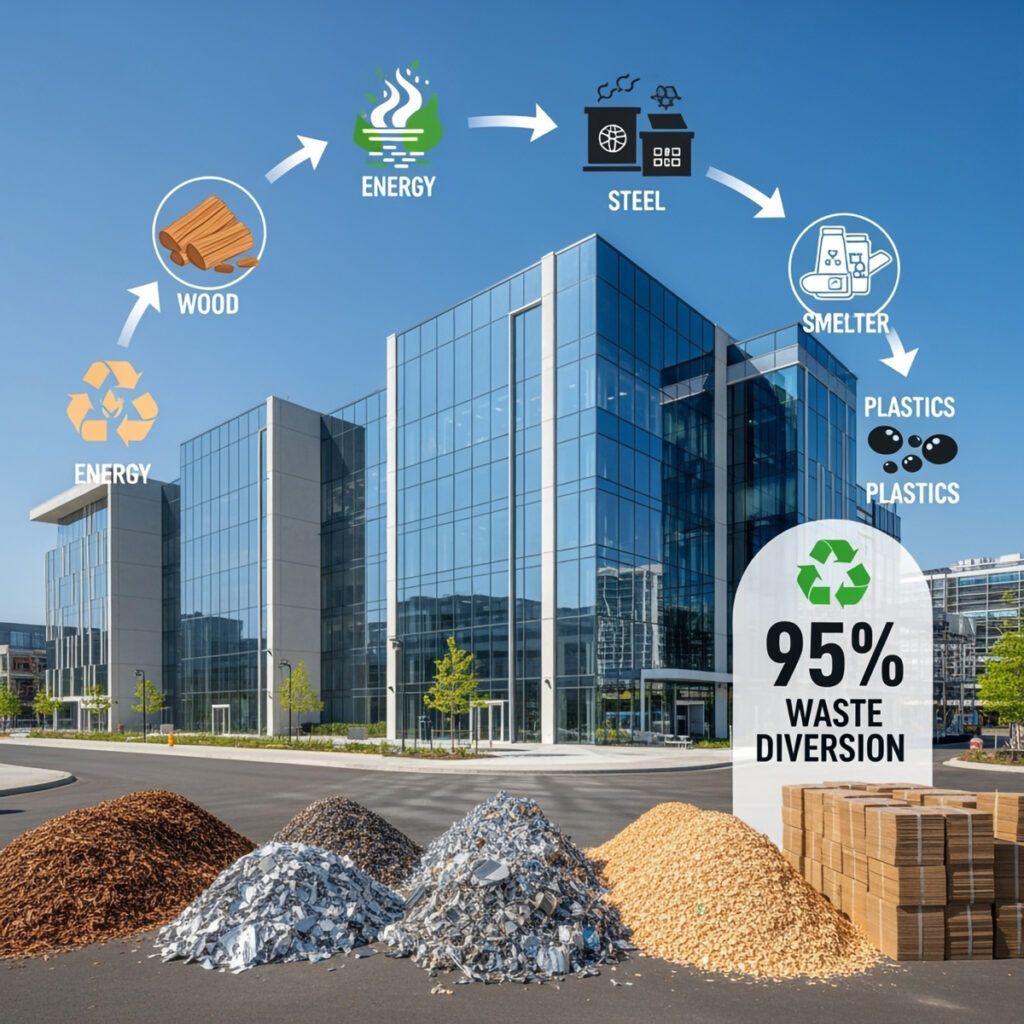
The good news is that diversion rates approaching 95% are not only possible—they already are being demonstrated on commercial construction projects around the world.
Why Diversion Matters
Waste diversion often is treated as a secondary concern, but for commercial construction executives, it intersects directly with the priorities that drive project success: cost, schedule, stakeholder expectations and long-term operational efficiency. Financially, landfilling is expensive.
Tipping fees, hauling charges and lost material value add up quickly, especially on large-scale builds like data centers. By contrast, diverting waste into reuse, resale or recycling streams can reduce costs and, in some cases, generate revenue.
Strategically, high diversion rates reinforce the sustainability commitments that owners, tenants and investors increasingly demand. With ESG reporting under growing scrutiny, a documented diversion rate of 90% or more provides a tangible, verifiable metric that strengthens credibility.
It also builds trust with tenants, particularly in sectors like cloud computing, healthcare and financial services, where sustainability performance influences site selection.
From an operational standpoint, diversion supports resilience. Global supply chain disruptions have demonstrated how vulnerable construction projects can be to raw material shortages. Treating waste as a resource—wood that can be resawn, metals that can be re-melted, plastics that can be reprocessed—creates buffers that reduce exposure to volatility and delays.
 Circularity in Action
The principles behind 95% diversion align with broader circular economy strategies. Instead of the traditional “take, make, dispose” model, circularity emphasizes keeping resources in use for as long as possible. A joint McKinsey and World Economic Forum study found that circular construction could abate 75% of embodied CO₂ emissions and generate up to $360 billion in net value by 2050.
Using recycled aggregates in cement, for example, can deliver up to 96% of possible abatement and $122 billion in net profits. Steel, aluminum, glass, and plastics all show similar potential for cost savings and carbon reduction when recycled at scale.
This is not just theory. Developers are beginning to embed circular practices into live projects. Digital Realty, one of the world’s largest data center operators, reported diverting more than 88% of construction waste from landfill through aggressive reuse and recycling initiatives. While not yet at 99%, this performance demonstrates that diversion well above industry averages is achievable in practice.
How to Get There
Achieving near-total diversion requires coordination across design, construction and operations. It begins with how projects are conceived. Designing for disassembly—using modular components, standardized panels and demountable systems—makes it easier to reclaim materials at the end of their initial use. Early engagement with suppliers can also help identify materials that are easier to recycle or that already contain recycled content.
Once construction begins, real-time tracking becomes critical. Digital platforms can log every pallet, crate, and container as it arrives on-site, then track where it goes when discarded. This level of visibility ensures accountability and allows project managers to intervene if a waste stream is headed toward landfill unnecessarily. Some systems even integrate with ESG reporting tools, providing auditable data for investors and regulators.
Relationships with local partners are equally important. Regional recyclers, remanufacturers, and energy recovery facilities must be lined up in advance to handle material flows efficiently. Wood, for example, can often be resawn into smaller pieces for resale. Pallets can be repaired and returned to circulation.
Wood residuals can be diverted to generate clean renewable electricity. Scrap steel and aluminum can go directly into regional smelters. Even plastics and cardboard, if sorted correctly, can be sold back into manufacturing supply chains. For the fraction of materials that cannot be reused or recycled, waste-to-energy conversion ensures that nothing goes to landfill.
Continuous improvement is the final ingredient. Diversion audits conducted throughout the project—rather than only at closeout—help identify opportunities to improve performance in real time. Contractors and owners who set daily or weekly diversion targets find it easier to sustain momentum and achieve higher yields.
The Payoff
For owners, contractors, and operators, the benefits of pursuing 99% diversion are multifaceted:
- Cost savings come from reduced landfill fees and the recovery of material value. On large data center projects, these savings can reach millions of dollars.
- Schedule stability improves as material reuse and recycling reduce reliance on unpredictable supply chains.
- ESG performance strengthens with auditable data that can be showcased to tenants, investors, and regulators.
- Market differentiation increases for contractors who can demonstrate sustainability leadership in competitive bids.
For facilities managers, high diversion during construction sets the stage for long-term efficiency. Materials reclaimed and documented in the construction phase can inform future renovations or expansions, reducing procurement costs and supporting ongoing waste reduction goals.
Lessons for Commercial Construction
While data centers represent a particularly resource-intensive segment, the lessons extend across commercial construction—from retail and hospitality to healthcare, education, and multifamily. Every sector faces similar pressures: budgets are tight, stakeholders demand transparency and sustainability is increasingly tied to brand reputation.
The path forward is clear. By embedding circularity into project planning, leveraging digital tracking, building local partnerships, and committing to continuous improvement, commercial construction teams can achieve diversion rates once thought impossible. The success stories emerging in the data center sector show that 95% to 99% diversion is within reach.
The challenge now is for the broader industry to embrace these practices and make them standard rather than exceptional.
The age of “take, make, dispose” is ending. Commercial construction has the opportunity to define itself by a new standard—one where the waste from today’s projects becomes the resource for tomorrow’s. Data centers, with their scale and visibility, are proving that it can be done. The rest of the industry has every reason to follow suit.






