










Modern healthcare facilities are being asked to do more than ever before. They must deliver uninterrupted patient care while balancing financial, sustainability, and operational goals. Increasingly, these priorities overlap, as resilience strategies are closely tied to both decarbonization efforts and building electrification.
Addressing them effectively requires integrated planning across building systems, energy infrastructure and facility operations.
At the same time, facilities are expected to remain operational during extreme weather events, utility disruptions, and emergencies that are becoming less exceptional and more routine.
For healthcare owners, the question shifts from simple code compliance to broader organizational preparedness: what level of performance is needed when the grid fails, water service is interrupted, or climate-related hazards intensify?
Traditional assumptions based on “100-year” weather events are becoming less reliable as storms, floods, and heat events occur with greater frequency and severity.
Because hospitals often serve as community anchors during disasters, decisions about backup power, flood protection, and system redundancy can directly affect a region’s ability to respond and recover.
 Identifying Evolving Climate Hazards
Effective resilient design begins with understanding the hazards most likely to affect a facility and how those hazards could disrupt operations. A regional hazard assessment is an essential first step, but historical weather data alone is no longer sufficient.
Owners and design teams are increasingly incorporating forward-looking climate projections to understand how risks may evolve over the life of the building.
Just as important is understanding secondary hazards and cascading failures. A hurricane may bring not only wind damage but also flooding, fuel shortages, staffing challenges, and supply chain disruption. During Winter Storm Uri in 2021, failures in power generation and fuel delivery caused widespread electrical outages, frozen infrastructure and water shortages in Texas.
Even facilities with backup generators experienced operational failures as water and steam heating systems froze. Events like these demonstrate that resilience cannot rely on any single protective measure; it must account for interdependencies between systems and infrastructure.
Flood exposure remains one of the most significant threats to healthcare facilities, whether from coastal storm surge, river flooding, or increasingly common inland flash floods. Extreme heat is another growing concern, placing additional stress on cooling systems and utility grids amidst increased patient demands.
Some risks also extend far beyond the immediate region. Wildfire smoke, for example, has become a national air quality issue, affecting healthcare facilities hundreds of miles away from active fires and driving the need for enhanced filtration and building pressurization strategies.
Because hospitals operate within a larger emergency response network, resilience planning should also extend beyond the facility itself. Coordination with local emergency management agencies, utilities, and regional healthcare systems can help align patient transfer plans, fuel prioritization, sheltering strategies and mutual aid resources.
Integrating MEP and Structural Design Strategies
Resilient healthcare facilities require mechanical, electrical, and plumbing (MEP) systems that are not only robust but also adaptable and capable of sustained operation under degraded conditions. One important strategy is to design the system architecture to allow isolation, load shedding, and phased reactivation by department or function.
This enables facilities to prioritize critical care areas while conserving limited resources during prolonged outages.
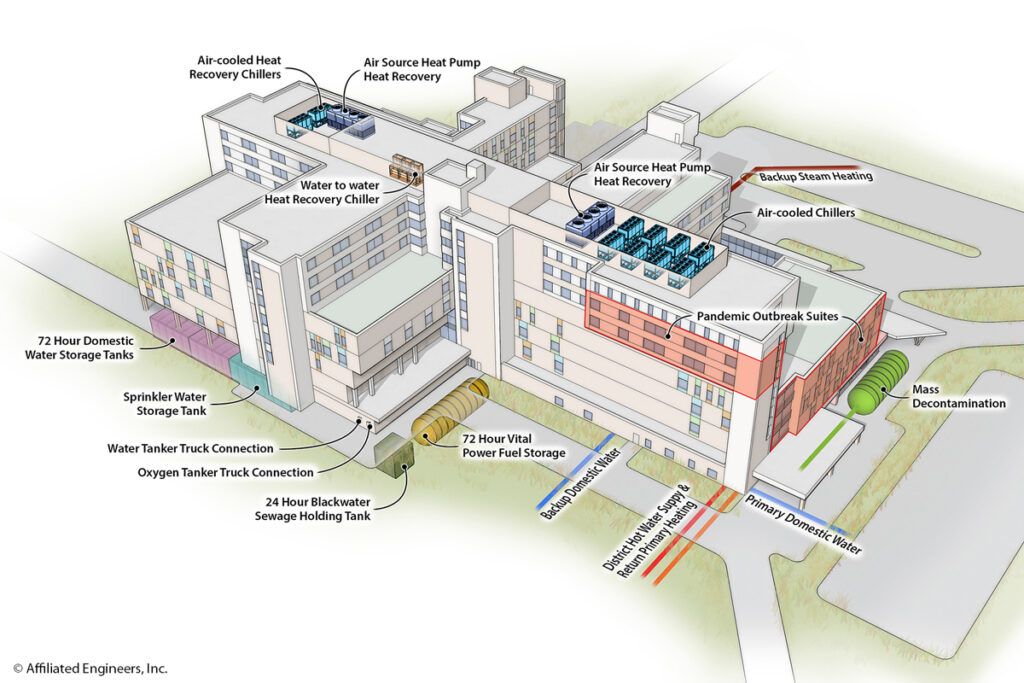
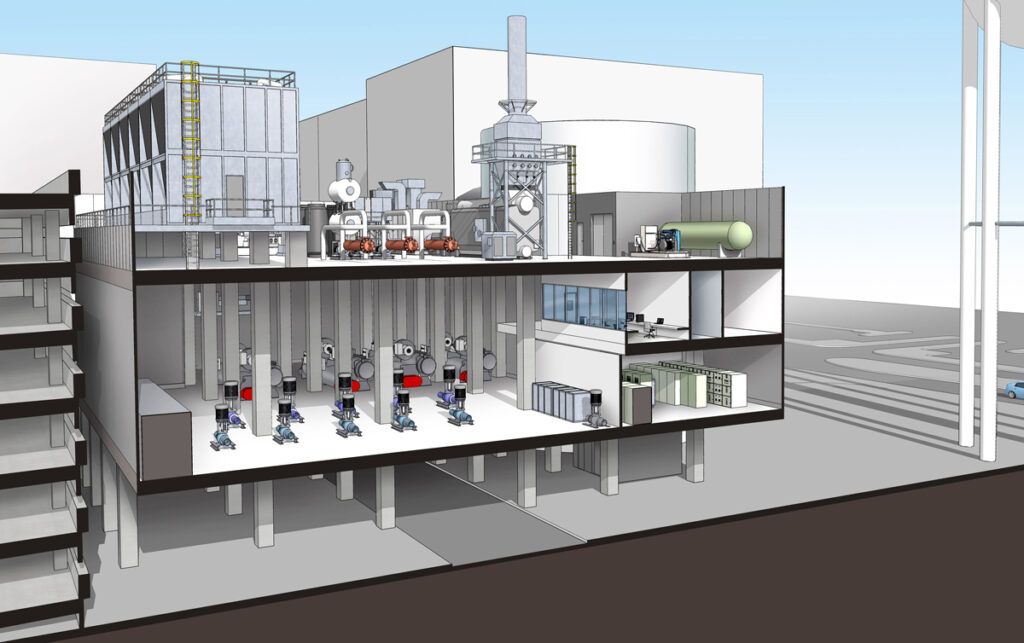
Redundancy also plays an important role, but redundancy alone does not guarantee resilience. Backup systems must be protected from the same vulnerabilities as primary systems. Locating critical equipment above flood elevations, physically separating distribution pathways, and protecting utility infrastructure from wind or water damage are all essential considerations.
Flexibility is another critical design objective. MEP systems should support future adaptability, including the ability to expand capacity, repurpose spaces or respond to changing care models during emergency events. Similarly, incorporating multiple energy and thermal sources, such as generators, microgrids, thermal storage or electrified systems, can reduce reliance on a single utility or fuel source.
Facilities should also include infrastructure for temporary emergency support systems, such as quick-connect provisions for portable generators, chillers, boilers or water supply systems. These features require coordination across MEP, architectural, civil and site disciplines to ensure accessibility during a disaster event.
Sustainability strategies can also strengthen resilience. Facilities with lower baseline energy and water consumption can operate longer on backup systems during utility disruptions. Water-saving measures, high-efficiency systems and heat recovery strategies not only support decarbonization goals, but also improve survivability during emergencies.
 Evaluating Risk with the DEVA Framework
Codes and standards are increasingly evolving to support this broader approach to resilience. One of the most significant recent developments is the Disaster, Emergency, and Vulnerability Assessment (DEVA), introduced in the 2022 Facility Guidelines Institute (FGI) Guidelines as part of the Safety Risk Assessment process.
Developed in response to lessons learned during the pandemic, the DEVA framework builds upon the annual Hazard Vulnerability Assessment by requiring project teams to identify risks and document how those risks will be addressed through design strategies, operational procedures or accepted risk.
Applicable to both new construction and renovation projects, the process moves resilience planning from a conceptual discussion into a documented and coordinated design exercise.
A key strength of the DEVA process is its multidisciplinary approach. It brings together designers, facilities staff, clinicians, security personnel, emergency management teams and supply chain representatives to evaluate how a facility is expected to function during emergency conditions.
This collaboration helps identify operational gaps early and translate them into measurable resilience requirements such as equipment placement, shelter-in-place capacity, redundancy levels and infrastructure hardening measures.
The DEVA also recognizes that healthcare systems are highly interconnected. Siloed solutions are often insufficient because disruptions in one system can quickly affect multiple aspects of patient care. By evaluating these dependencies early in the design process, healthcare organizations can develop more comprehensive and coordinated resilience strategies.
Resilience is No Longer Optional
Resilience in healthcare design is no longer a supplemental goal; it is a foundational requirement. Rather than functioning as a checklist of isolated measures, resilience must be approached as an integrated design philosophy influencing decisions from early planning through long-term operations.
The most effective projects are those that align resilience with other objectives such as sustainability, electrification and operational efficiency.
Frameworks like the DEVA demonstrate how codes and standards can serve not only as compliance tools but also as opportunities to bring diverse stakeholders together and develop more cohesive resilience strategies. Ultimately, resilient healthcare design is not just about protecting buildings or infrastructure. It is about safeguarding patient outcomes, maintaining continuity of care, and preserving community trust when it matters most.
Joss Hurford, PE, LEED AP BD+C, is a resilience consultant at Affiliated Engineers Inc. (AEI), where he specializes in resilience and sustainable strategies that help organizations reduce vulnerability and support long-term operational continuity. His work focuses on developing and applying advanced modeling tools to analyze climate hazards and evaluate the effectiveness of mitigation and adaptation strategies.
Sean Lawler, PE, LEED AP, is a principal at Affiliated Engineers Inc. (AEI), focusing on energy-intensive and highly specialized environments, including healthcare and research facilities. He leads the design of high-performance and resilient buildings with expertise in heat recovery systems and complex phasing challenges.




