











Through more than 20 years of neglect and abandonment, Clayborn Temple’s physical condition belied its importance to the American Civil Rights Movement. As if purposefully cast to be an anamorphic metaphor, Clayborn Temple in Memphis, Tennessee had become a decrepit old soul with a broken back, crumbling in on itself. The roof had failed. Windows were broken. Masonry had crumbled and the main roof truss had largely collapsed with catastrophe staved off by an emergency shoring effort.
This tragic deterioration disguised Clayborn Temple’s proud heritage and central role as the staging ground for the 1968 Sanitation Workers’ Strike that precipitated Dr. Martin Luther King’s fateful trip to Memphis. In fact, the iconic “I AM A MAN” signs were made daily in the church’s basement as a means to proudly demand the most basic of human rights and dignity.
In February 1968, more than 1,000 black sanitation workers initiated a strike, protesting inadequate wages and harsh conditions. Their pleas for change initially fell on deaf ears among city leaders, prompting them to join forces with Civil Rights activists, including Dr. Martin Luther King, Jr. During his visit to support the strike, Dr. King was assassinated as he stepped out onto the balcony of the Lorraine Motel.
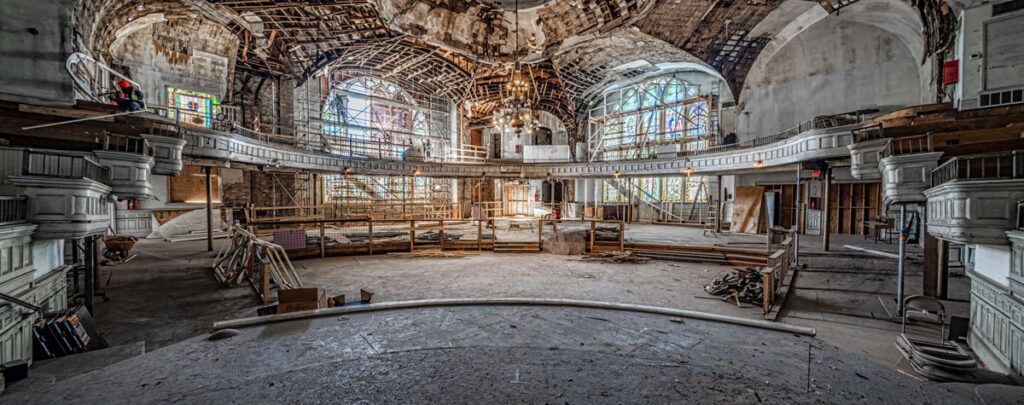 The fallout from King’s death and the end of the strike saw Clayborn Temple fall into disrepair. The nearly seventy-five-year-old building was eventually shuttered despite efforts to maintain its operations throughout the 1980s. The continued challenges of preserving such a monumental building proved daunting.
Hope for Clayborn Temple’s revitalization emerged when it was designated a National Treasure by the National Trust for Historic Preservation in 2018. Under the leadership of Anasa Troutman, the newly established 501(c)3 non-profit, Historic Clayborn Temple, assembled a highly accomplished building committee to guide plans for its revitalization.
The project has attracted funding from a number of private sources, including Kataly, Kresge, and Mellon Foundations, as well as a $2.5M 2025 Community Projects Award through Congressman Steven Cohen (D TN, 9th District), which will help to fund the third and final restoration phase (interior envelope) required for the building to reopen.
Today, Clayborn Temple is being painstakingly returned to its rightful place in American History—a canvas for the art of life, a dignified counterbalance to injustice, and the fundamental human instinct to create community. Once complete, the collaboration of hundreds of skilled craftsmen, artists, designers, preservationists and public officials will have resurrected the condemned church to reflect its 1968 stature.
As Clayborn Temple peers into the future, its resilience will echo that of the sanitation workers themselves—beckoning to future generations to continue to advance the cause of equality on the hard-won foundations of our forefathers.
Frequent collaboration between preservation consultants, architects, engineers, and skilled craftspeople has been necessary to ensure adherence to the Secretary of the Interior’s Standards for Rehabilitation. LRK is guiding historic preservation efforts for Clayborn Temple in coordination with the National Park Service and Tennessee Historical Commission. Self Tucker Architects is leading the architectural team tasked with restoring the building, and Allworld Project Management serves as Project Manager for this herculean effort.
“By the early 2000s, the building had suffered significant deterioration, even requiring the partial demolition of a collapsed section,” says Greg Morrison, Historic Preservation Consultant at LRK. “The main sanctuary building has left an incredible dome structure in the center that creates a complicated structural system. The deteriorating roof was exerting immense pressure on the south exterior wall, causing it to lean outwards and become unstable.” This failure ultimately necessitated careful disassembly of the south wall, individually numbering each stone for reconstruction.
The completion of exterior work in September 2023 marked a significant milestone, revealing a fully restored envelope adorned with revitalized stained-glass windows that pay homage to the building’s rich history. With this major phase accomplished, the team has now turned its attention to the intricate task of restoring the interior.
“Historic photos have helped us to really refine efforts so that they reflect the period of significance that’s most important to this building,” Morrison says. “For example, old photos helped us determine the types of doors used in the 1960s compared to newer ones that were later updated in the 1980s. All updated doors from previous restoration attempts were then switched back to doors that reflect the 1960s time period.”
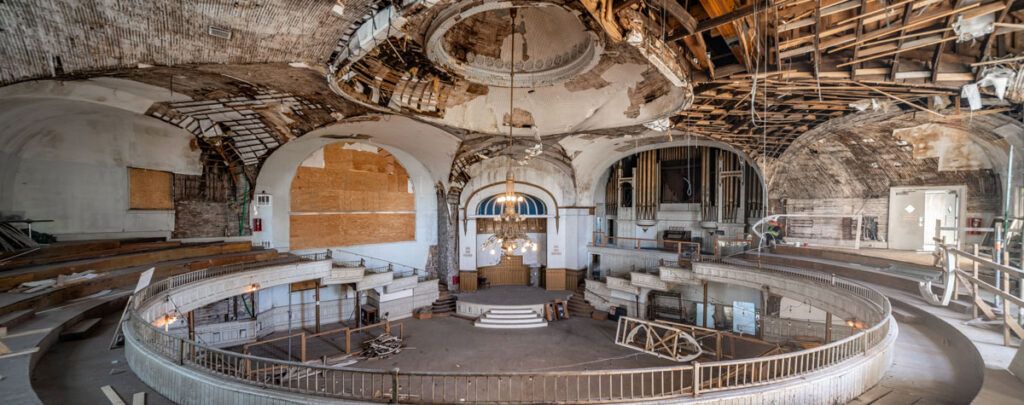 This same process was extended to the interior lighting. The team found the sconces lining the sweeping cantilevered balcony were from the 1980s, but the light shades had been salvaged and dated to the church’s initial construction.
The sanctuary’s intricate dome structure will undergo comprehensive restoration, facilitated by advanced 3D scanning and digital modeling. The original chandelier, meticulously restored and converted to LED compatibility, will once again grace the center of the dome. Having endured the building’s most challenging periods, the chandelier now serves as a poignant symbol of Clayborn Temple’s resilience and rebirth.
“Throughout the past seven years, the Design Team has strived to highlight the important legacy of Historic Clayborn Temple and its position at the heart of the community through the highest expression of historic preservation, environmental sustainability and community revitalization,” says Jimmie Tucker, Managing Principal at Self Tucker Architects.
The restoration of the church’s interior is slated for completion in 2026. Upon its reopening, the revitalized Clayborn Temple will not merely resume its role as a place of worship, but it will also house a museum dedicated to the Civil Rights movement, paying homage to the landmark campaign that unfolded within its walls.
Furthermore, the temple will serve as a versatile venue for community-led programs and activities. These efforts represent an enduring contribution to Memphis’s Civil Rights landscape, perpetuating awareness of the stories of local achievement and activism that shaped the nation’s history.
Tony Pellicciotti, AIA, LEED AP, BD+C, brings more than 30 years of highly relevant leadership, collaboration and design experience to LRK. With a broad, diverse portfolio, he has focused his professional practice to prove that good design transcends budget and program.




