









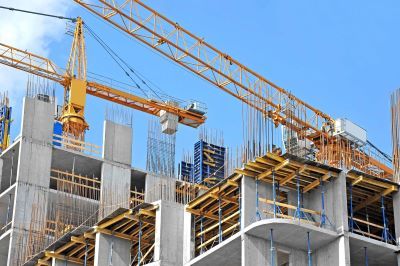
Concrete is the world’s most widely used construction material. Although extremely durable, its chief vulnerability is corrosion. This occurs more readily on aging structures but can also attack new concrete located in hot, humid seaside climates or regions that rely heavily on deicing salts. Accordingly, rows upon rows of green epoxy-coated rebar are often seen staged at construction sites for enhanced protection. However, it is important that engineers and contractors understand this may not be an end-all to their corrosion worries and they need to be aware of alternative methods for overcoming the deficiencies of epoxy-coated rebar.
Epoxy Coating Deficiencies
If the epoxy coating on rebar were to remain undamaged, it would provide exceptional protection by creating a thick barrier to corrosives. Unfortunately, coating damage is all-too-common. As epoxy-coated rebars roll off the paint line and get bundled for shipment to some jobsite, their most vulnerable stage begins. Cortec® CEO, Boris Miksic, pointed out that, “When coated rebars are transported, bent, welded, and installed there is a great probability that the coating will be physically damaged. The damaged areas will be[come] small anodes coupled to large coated areas [that become] cathodes, causing pitting failures.” The question, then, is how to find a backup technology that inhibits corrosion at these points.
A Molecular Protective Layer
Migrating Corrosion Inhibitors (MCI®) are an exciting, versatile, and budget-friendly option. Applied as an admixture or a surface treatment, MCI® chemistry works its way through concrete pores and forms a protective molecular layer on the surfaces of metal reinforcement due to an ionic attraction. Hence, it can protect an entirely uncoated rebar or molecularly fill in damaged areas on an epoxy-coated rebar where the metal is exposed. MCI® is classified as a “mixed” inhibitor because this molecular layer affects both anodic and cathodic portions of the corrosion cell. MCI® can double or triple the time to corrosion initiation and significantly reduce corrosion rates once started.
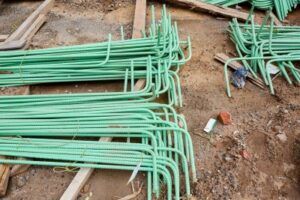
Image Courtesy of: Cortec Corp
Comparing MCI® and Epoxy-Coated Rebar
MCI® admixtures such as MCI®-2005 (a USDA Certified Biobased Product) or MCI®-2005 NS are easy to work with when added to ready-mix at the time of construction. Specifying engineers can use service life prediction modeling to estimate and compare how much MCI® is expected to extend service life in various environments vs. the projected performance of epoxy-coated rebar. The differences can be significant. In one Gulf Coast project, the MCI®-2005 service life prediction surpassed the projected service life of epoxy-coated rebar while saving the project hundreds of thousands of dollars. Although MCI® can be used as a total replacement for epoxy-coated rebar, those who desire extra “insurance” and have the budget to do so can specify MCI® alongside epoxy-coated rebar for complementary backup protection in areas where the coating may be damaged.
What If the Damage Is Already Done?
Sometimes, the contractor has already seen damage on the rebar coating, but it is too late to specify an MCI® admixture for a project underway. Fortunately, builders still have the option of adding an MCI® surface applied corrosion inhibitor (SACI) once the structure is completed. MCI®-2020 contains the highest concentration of MCI® for any SACI on the market and can be sprayed or rolled onto existing structures. It moves first through the concrete matrix by capillary absorption and then by vapor diffusion, gradually migrating as much as several inches into the concrete to reach and protect the embedded rebar.
Start Exploring the Costs/Benefits of MCI®
Epoxy-coated rebar can look like an attractive option until peering more closely at the price and potential concerns of coating damage. Since MCI® offers to extend service life at a much lower fraction of the total construction cost, engineers should carefully consider specifying MCI® as either a complement or complete replacement to epoxy-coated steel. Contact Cortec® to learn more about the costs/benefits of MCI® versus epoxy-coated rebar.
Feature Image Courtesy of: Cortec Corp




