










There is no shortage of noise around artificial intelligence (AI). From boardrooms to job sites, AI is being positioned as the technology that will rewrite the rules of efficiency and productivity.
At the end of 2025, just 12% of construction companies reported regular use, while 45% have no AI implementation. The gap between promise and payoff is widening; margins continue to be squeezed while risk is ever-increasing, and yet AI is not doing anything to address either of these in the world’s most exposed and risk-averse business. On today’s projects, AI remains largely aspirational.
In 2026, the projects and companies that achieve meaningful productivity gains will not be the ones using AI. It will be the companies who are doubling down and investing in automation, which may or may not be AI-enabled — in order to remove repetitive administrative work, standardize workflows, and build the operational foundation which AI depends on to deliver value.
It’s a Game of Risk
I am not blind to the awe and wonder of some of the applied use of AI. In a sector that contributes around $13 trillion to global GDP today—projected to reach $22 trillion by 2040—and employs millions worldwide, AI could reduce the complexity, at scale.
Nevertheless, many firms across industries have yet to realize return on investment for AI. In fact, a report by PWC of over 4,400 CEOs found that 56% saw neither increased revenue or decreased costs from AI initiatives despite significant financial and time investments
In construction, in particular, there are two critical barriers that AI adoption faces. First, there’s the issue of trust. Construction leaders are understandably hesitant to base high-risk decisions on unproven tech in a sector where one error can lead to catastrophic financial or safety consequences.
Second, AI works best when inputs are clean, structured, and consistent. This is the data foundation that many enterprises still lack. Interestingly, this is exactly where we are seeing a lot of AI development for the industry: using AI to clean the data itself.
Given the impracticality of performing this time consuming task manually, AI is being deployed to learn and analyze 3D model structures and identify, for example, which materials are best suited to specific component parts.
The technology can then automatically call out if the wrong materials are being considered, fixing the data foundation before it leads to a project failure.
Investment in AI technology in construction is falling into the better mousetrap fallacy—prioritizing innovation before fixing the workflows and data that make adoption possible. In an industry defined by risk, any technology that is applied to this sector must fundamentally improve project execution.
 Managing the Risk
Construction is not short on complexity. From billion-dollar infrastructure programs to refurbishment projects constrained by live environments, teams are under pressure to deliver on time, on budget and without rework. But the sector is still reliant on fragmented communication, unreliable information, analog tools and legacy workflows.
Spreadsheets, email threads, and siloed models create friction. Layering AI on top of unstructured data and inconsistent workflows does not create intelligence, it amplifies noise, inefficiencies and cost. Consider predictive AI applied to clash detection without structured model coordination. It may generate hundreds of “potential conflicts,” most of which are false positives.
Teams will then spend more time validating AI output than they would have solving the issue manually. Every hour a project manager spends chasing paperwork or reconciling systems is an hour not spent managing the risk or moving the project forward.
 Why Automation is the Game Changer
Automation is not about intelligence, but it is about consistent processes and execution across day to day operations. It’s about getting the basics right from the start.
But not all automation is equal. Automation is at its best when it is working with connected datasets and workflows, rather than reinforcing existing data silos. Too many tools focus on “automating” isolated administrative tasks or document management structures. While these are important for governance, they do little to truly enhance productivity or onsite delivery.
This is why automation has already proven its value through BIM-based workflows, enabling teams to manage large, federated models and seamlessly integrate 2D and 3D coordination as projects grow in complexity and scale. While automation improves speed and clarity, its highest impact is risk reduction—delivering more predictable cost and schedule outcomes by enforcing consistent, rules-based coordination.
This consistency in the data is automation’s real advantage, freeing up teams to focus on higher-value work while effectively managing the balance of risk and reward.
In today’s competitive landscape, automation in construction must cover coordination across 2D and 3D contexts, combined with workflow management and reporting and compliance.
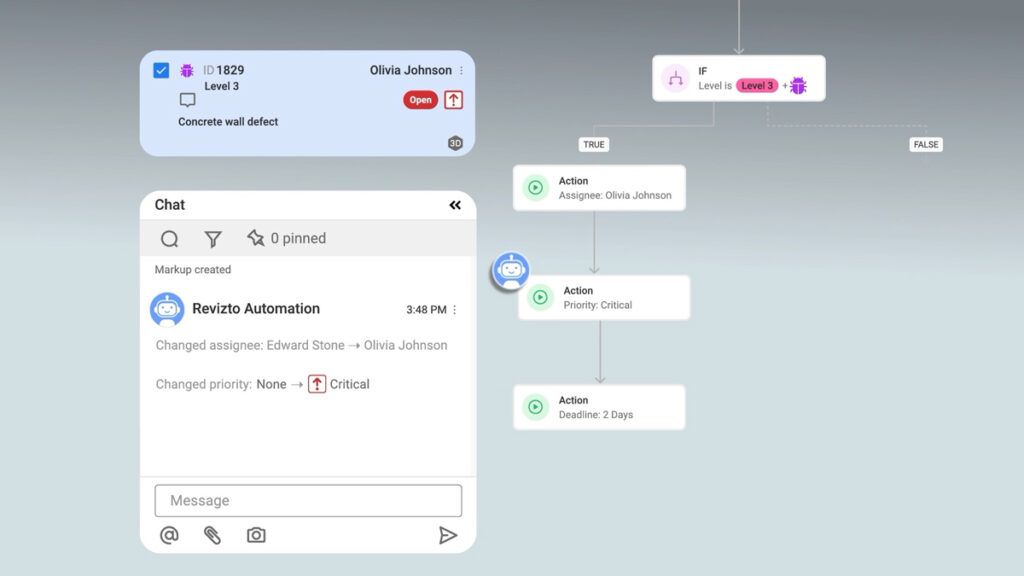
The automation needs to be seamless and handle processes that can tie them directly to issues on the model, tasks and notifications that actually matter to project teams.
For example, automation can be used to reduce manual clash checks and catch design issues earlier.
Reporting, submittal logs and audit trails can also be generated automatically, easing administrative burden and supporting compliance.
AI will increasingly play a larger role over time, acting as a productivity booster by helping teams analyze data, prioritize work or remove low-value tasks. But progress in 2026 won’t come from chasing the AI hype, nor will it come from using the same processes, and analog tools we are used to. It will come from investing in automation that standardizes and streamlines workflows.
Construction and engineering companies that get the basics right will define the industry standard, long before AI enters the equation.
Arman Gukasyan is founder and CEO of Revizto, a cloud-based visual collaboration platform (BCP) designed for the architecture, engineering, construction and operations (AECO) industries.






