








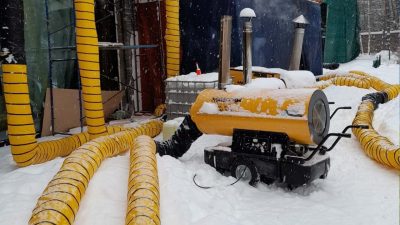
Temporary construction heaters are invaluable assets in the construction industry, especially when the weather turns cold and challenging. These are not just harbingers of warmth but also a great way to boost the productivity and well-being of construction professionals.
The market has a great many options for you to choose from when it comes to temporary construction heaters. So, today, in this article, we will provide you with a comprehensive guide on the types of commercial construction heaters and their diverse applications in temporary construction sites.
Exploring The Applications Of Temporary Construction Heaters
Temporary construction heaters are multifunctional solutions that find applications in a wide variety of construction scenarios.
They play a crucial role in maintaining controlled temperatures, enabling tasks such as concrete curing and paint drying, and providing optimal working conditions for construction crews.
Everything from large building renovations to smaller concrete pours, these heaters can make work easier and smoother at every step whenever the weather does not go as expected.
The Various Types Of Temporary Construction Heaters
The types of temporary commercial construction heaters available in the market are many to many. While each serves you in its own way and comes with a set of impressive functions, you may have a specific need.
Your ideal construction heater may have a certain working mechanism, size, heat function, or similar aspects that will add value to your purposes on the construction site. This utility is best decided upon when you gain a proper understanding of the options available to you-
Box Heaters
Box heaters, as the name suggests, are compact and portable. They fulfill localized heating requirements with ease.
They are great for spot heating and can be moved around or across the construction site much more easily. You can direct heat to a smaller and certain area of the project, which makes this a flexible heating solution.
Convection Heaters
Convection heaters work by circulating warm air within a closed space. They are wonderful for when you wish to save power but also get value for the energy you do allow for spending.
On-site offices and workshops are especially benefitted by this due to the comfortable working environment it creates even when the weather outside becomes cold enough to hinder construction work.
Forced Air Heaters
Otherwise known as blower heaters, forced air heaters are designed to constantly blow heat towards larger areas with efficiency.
Temperatures can rise quickly when a forced air heater is at work, making sure warehouses and large construction sites remain in the ambit of a healthier, bearable temperature during work hours.
Indirect Fired Heaters
Indirect-fired heaters are a clean option that emits cleaner, drier, and fume-free heat. Closed spaces that need both heat and ventilation benefit the most from these heaters.
Indoor construction sites that function in sensitive environments need manageable air quality, and these heaters are perfect for that.
Direct Fired Heaters
Direct-fired heaters aim at the space ahead of them to send off heat. These only work well with proper ventilation setup and are highly cost-effective. These are also quite powerful and are perfect as a heavy-duty companion to construction sites.
Portable Electric Heaters
Portable heaters are the very design that promotes mobility. These are great for construction jobs on the move, temporary sites, and office setups. There are no harmful emissions in a portable electric heater, only effective heating.
Radiant Heaters
Radiant heaters are intuitive solutions that warm people and objects directly within their reach. This is an outdoor application that makes a place as a construction site much more comfortable to work in during colder conditions.
Unit Heaters
Last but not least, unit heaters are the much larger and more powerful solutions for spaces with high ceilings. They work towards consistent warmth for closed construction sites, enabling a safer and more comfortable working environment for everyone.
Conclusion
This wide array of temporary construction heaters is wonderful applications to any construction site, serving any purpose from providing adequate temperatures to helping with the jobs on site.