










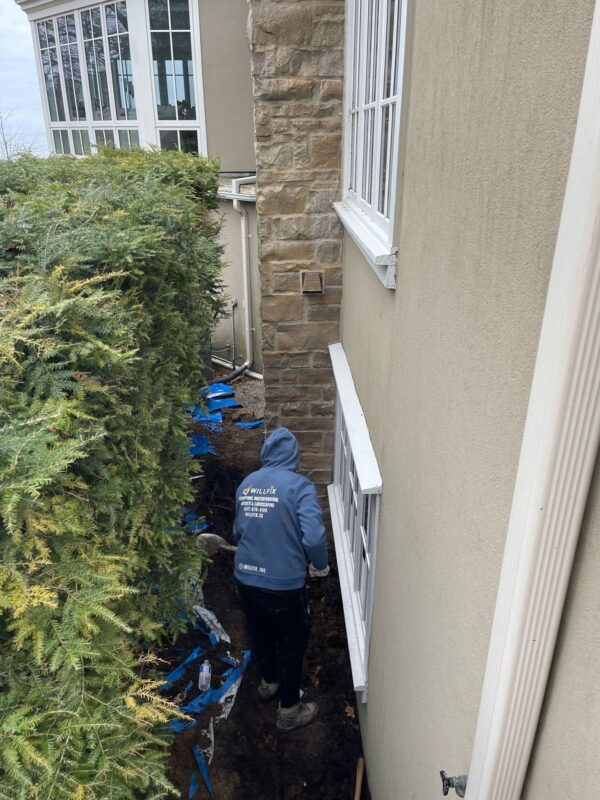
As construction standards evolve and the GTA’s built environment ages, below-grade envelope protection has become one of the more technically demanding disciplines in the industry. Here is what contractors and developers working in the region need to understand about current methods, failure modes, and best practices.
Foundation integrity is the assumption every other element of a building rests on. In the GTA, where freeze-thaw cycles are severe, soil profiles vary across short distances, and the housing stock spans pre-war brick to modern insulated concrete form, there is no single approach that works everywhere. Contractors and developers who understand the full range of foundation repair Toronto professionals encounter on a daily basis are better positioned to spec the right solution the first time – rather than returning to a property after water has already done its work.
The GTA’s Soil and Climate Challenge
The Toronto region sits primarily on glaciolacustrine deposits – fine-grained clays and silts left by ancient glacial lakes. These soils have high plasticity: they expand significantly when wet and contract when dry. For foundation design and remediation, this creates several compounding factors:
- Footings must reach below the frost line – minimum 1.2 metres in Toronto
- Foundation drainage systems must accommodate high hydraulic conductivity demand during spring thaw
- Walls in clay-dominant areas face sustained lateral earth pressure that increases with soil saturation
- Differential settlement is significantly more common than in granular soil zones
Areas closer to the lake tend to have deeper clay deposits. The Oak Ridges Moraine to the north transitions to more granular profiles. Site-specific geotechnical assessment remains essential for any project where below-grade performance matters – and in the GTA, that is most projects.
Current Protection Methods Compared
| Method | Best Application | Expected Lifespan | Relative Cost |
|---|---|---|---|
| Crystalline waterproofing (cementitious) | New construction, positive-side application | Life of structure | Moderate |
| Thermoplastic sheet membrane | Below-grade walls in new builds | 40-60 years | Moderate-High |
| Spray-applied polyurethane membrane | Renovation and retrofit work | 20-40 years | Moderate |
| Polyurethane injection (crack repair) | Active cracks in poured concrete, retrofit | 10-25 years | Low-Moderate |
| Interior perimeter drainage + sump | Retrofit – manages water after entry | 20+ years (pump-dependent) | Moderate |
| Full exterior excavation + membrane | Complete retrofit, addresses source | 25-40 years | High |
Ontario Building Code Requirements
The Ontario Building Code distinguishes between dampproofing and waterproofing – a distinction that matters considerably in the GTA’s clay soils. Dampproofing (typically a single bituminous coat) is designed to resist soil moisture only. Waterproofing resists hydrostatic head – the pressure of standing water against the wall surface.
In Toronto-area clay after significant rain or snowmelt, hydrostatic conditions are common. Code permits dampproofing in many residential applications, but field performance in clay-heavy areas frequently makes full waterproofing the only option that holds over multiple seasons. Division B of the Ontario Building Code (Part 9 for houses, Part 3 for larger buildings) outlines the minimum requirements – but minimum code compliance and long-term performance are not the same thing in this soil environment.
Common Failure Modes in Existing GTA Stock
Bituminous membrane degradation: Homes built before the mid-1990s were typically waterproofed with tar-based products that become brittle at cold temperatures. These coatings crack during freeze-thaw cycles and lose adhesion at the wall-footing junction – the highest-stress point in the system and the most common water entry location.
Failed weeping tile: Original clay or concrete tile drainage systems collapse, become root-infiltrated, and silt over time. Camera inspections of homes over 40 years old frequently reveal completely blocked or structurally failed tile. No amount of surface repair addresses a drainage system that is no longer draining.
Settlement cracks: Differential settlement in clay soils produces cracks that may not be structurally significant on their own but serve as direct water pathways. Polyurethane injection is effective for active cracks when hydrophilic formulations are used – flexible enough to move with the structure and to activate on contact with water.
Diagnosing Before Specifying
The most common and costly error in below-grade remediation is addressing the symptom rather than the cause. Interior drainage manages water after entry but does nothing to the failed exterior membrane driving hydrostatic pressure. Crack injection seals a pathway but ignores the drainage tile failure that is pressurizing the entire wall. A complete assessment should include visual inspection of all accessible wall surfaces, sump pit and pump condition, and where feasible, a camera inspection of the drainage tile run. Skipping the diagnosis step to save time rarely saves money.
References
- Ontario Building Code Act
- National Research Council Canada – Building Science
- CMHC – Moisture in Basements
Feature Image Source: WillFix (willfix.ca)






