










A properly specified trench drain is designed to capture high volumes of liquid—and, where needed, solids—across a broad area rather than at a single collection point. Also called a channel drain, it uses a long, grate-covered inlet to collect runoff along the length of the channel. This configuration can accommodate sudden washdown flows, process liquids, stormwater and solids-laden discharge that may overwhelm smaller point-drainage systems.
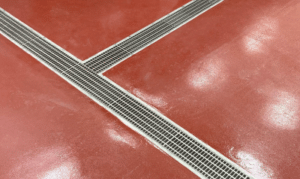
Image Courtesy of: GDT
In processing environments, removable grates and properly sized strainer baskets allow teams to access the channel, remove collected solids and help protect downstream plumbing from debris. That makes trench drains particularly useful in areas such as food and beverage processing, industrial manufacturing, animal care and loading or exterior hardscape applications.
Yet trench drainage is often treated as a late-stage commodity decision, even though errors in material selection, hydraulic capacity, grate choice, load rating and installation details can create costly long-term consequences.
Those errors are expensive because a trench drain cannot be unbolted and swapped out. It is cast into the floor, and therefore it should be specified to the same standard as the slab around it. A well-built concrete floor may remain in service for decades, and the drainage system embedded within it should be specified with a comparable lifecycle in mind.
The most reliable approach is to specify trench drainage as an integrated system rather than as a channel, grate and outlet selected independently. Channel geometry, slope, traffic loading, catch basins, solids management, floor interfaces and installation methods all affect long-term performance. When those elements are designed to work together, facilities can reduce maintenance demands, protect sanitation conditions and avoid disruptive remediation later.
Why Lifecycle Cost Matters
Drainage decisions should be evaluated across the life of the floor, not only by first cost. A well-engineered system can simplify installation, support efficient sanitation and maintenance, and reduce the risk of premature replacement within an operating facility.
Installation
The savings begin before the drain carries any water. A pre-sloped, modular system places the slope inside the channel, allowing crews to set the top level with the finished floor rather than form the grade by hand. By reducing field-controlled variables, these features can streamline installation, improve consistency and reduce the likelihood of costly rework.
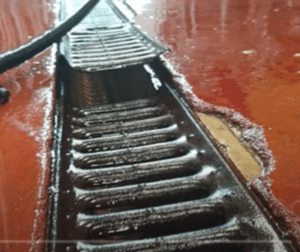
Image Courtesy of: GDT
Daily Operation
A drainage system that is difficult to clean or poorly matched to the facility’s flow and solids load can create recurring operational problems. Clogs consume maintenance time, may require outside drain-cleaning support and can contribute to water backup, sanitation concerns and production disruption. As facilities increase throughput, extend operating hours and work with leaner maintenance teams, drainage systems must support evolving production, traffic and sanitation demands over the life of the building.
Longevity
The strongest argument for a quality drain system is the difficulty of replacing one. A failed drain is not a repair job. It is a construction project inside a working building. Crews saw and break out the concrete, remove the old drain, set and anchor the new one, pour fresh concrete, and wait for it to cure. Every hour the floor is torn up is an hour that space cannot be used, and the work has to fit a plant’s limited planned shutdown window or cause costly production stoppage.
How Trench Drains Fail
Understanding common failure modes helps project teams make more informed specification decisions. In practice, drainage problems often stem from three sources: materials that are mismatched to the operating environment, an improperly designed or installed floor-to-drain interface, and inadequate solids-management or maintenance practices.
Materials That Do Not Last
Plastic systems may be unsuitable for applications involving repeated exposure to high-temperature liquids, aggressive cleaning agents or heavy process demands. In one brewery application described by drainage specialists, high-temperature discharge damaged plastic trench components, underscoring the importance of matching material selection to actual operating conditions.
In wet, washdown-intensive environments, cast iron grates and components can corrode over time. Frequent exposure to caustic cleaning chemicals may accelerate oxidation, pitting and deterioration, particularly where corrosion-resistant stainless steel would be better suited to the application. At one new honey plant, the grates the plumber selected were corroding within months of startup. A trench formed directly in concrete can also become difficult to clean and maintain. As coatings deteriorate, exposed aggregate and irregular surfaces can create persistent sanitation and repair challenges.
The Joint Between the Drain and the Floor
The second failure point is the seam where drain meets concrete, which usually gives out long before the drain body does. Two forces attack it. Forklift traffic vibrates the floor, and a drain that flexes under load pulls away from the concrete on one stroke and presses against it on the next, opening gaps along the edge. Hot water and aggressive cleaners break the bond between coating and drain chemically. Once the floor-to-drain interface opens, moisture and soils can migrate beneath the surface, creating an area that is more difficult to access and sanitize effectively.
Clogging and Maintenance
The third failure is a maintenance problem before it is a drainage problem, because a drain that is hard to clean stops being cleaned. A grated channel requires a practical process for lifting, cleaning and correctly reinstalling grates. Strainer baskets should stop solids at the surface, but when they are removed and not replaced, debris reaches underground piping, where blockages can build until water backs up onto the floor. In exterior applications, leaves, grit and sediment can accumulate when channel geometry, slope, outlet capacity and maintenance access are not matched to the expected stormwater and debris load.
Trench, Slot, or Area: Matching the Drain to the Space
The best drainage strategy starts with the application, not with a preferred product. Many facilities require a combination of trench, slot and area drains, selected according to flow volume, solids load, sanitation requirements, traffic conditions, floor layout and maintenance access. Trench drains are typically appropriate where high volumes of liquid, solids or both must be managed across a broad area. Their wide inlet and accessible channel can support rapid collection and solids handling when paired with properly selected grates, catch basins and strainer baskets.
Area drains can be effective for localized drainage zones, while the number, placement and spacing of drains should be determined by the floor plan, expected flow and process conditions. Slot drains may be preferable in highly hygienic areas where a narrow, grate-free inlet supports simplified cleaning and a minimal floor interruption. In exterior applications, final drain selection should also account for the hydraulic effect of grate design: decorative grates can restrict inlet capacity, making a slot-drain configuration more appropriate in some applications.
How to Specify a Trench Drain That Lasts
A durable trench drainage system depends on a coordinated set of specification decisions. The following considerations determine whether the system can manage the intended flow, traffic, sanitation and maintenance demands over the life of the floor.
Material
Material selection is crucial. Grates and baskets can be replaced, but the drain body is encased in concrete. Type 304 and Type 316 stainless steel are commonly selected for hygienic and industrial applications because they offer corrosion resistance, durability and a nonporous surface that supports cleaning. The appropriate grade should be selected according to the chemical environment, temperature exposure, process conditions and applicable facility requirements.
Pre-Sloped Construction
A drain system with pre-sloped channel modules can simplify the installation process. The slope is manufactured into the channel: the top stays level while the bottom steps down section by section according to the drainage design.
The installation team can focus on setting the drain top flush and level with the finished floor while verifying anchoring, alignment and required interface details before the concrete pour. Documented invert depths can help the design team coordinate channel elevations with below-floor plumbing before construction begins.

Image Courtesy of: GDT
Body Shape
The shape of the trench drain channel body should match the specific requirements of the application.
● Round bottom: Commonly selected for hygienic manufacturing because its curved profile eliminates sharp internal corners and supports more effective cleaning and drainage.
● V-bottom: Can be appropriate where depth is limited and a shallower profile is required. The angle and configuration should support the application’s cleaning and solids-management requirements.
● Flat bottom: Often used in stormwater and industrial drainage applications where the primary design priority is flow management rather than hygienic cleanability.
Size and Flow Capacity
Trench width, channel depth, slope, grate configuration, outlet size and run length must be coordinated with the anticipated liquid volume, solids load and discharge conditions. Hydraulic capacity should be confirmed for the specific configuration rather than estimated from channel width alone. Long runs require careful outlet and catch-basin placement to maintain flow, provide cleanout access and protect downstream plumbing.
Complex projects, such as those with multiple drain runs, custom intersections, shallow slabs or constrained shutdown schedules, benefit from early coordination. A modular, factory-engineered system can provide predictable channel elevations and repeatable connections while accommodating application-specific layouts, catch-basin locations and slopes.
Grates and Traffic
Traffic loading should be evaluated according to wheel load, wheel material, contact area, frequency of travel and the quality of the floor-to-drain transition—not simply the gross weight of the largest vehicle in the facility. Forklifts, pallet jacks and carts can create concentrated repetitive loads, particularly at transitions that are not flush or at grate openings that are too large. Over time, repeated impacts can damage the grate, frame or adjacent floor interface, even when the overall vehicle weight appears modest compared with larger equipment.
The grate should sit solidly in its frame without rattling and be selected according to a verified load rating rather than a fabricator’s estimate. Where operationally appropriate, interchangeable grates can simplify cleaning and reinstallation by allowing sanitation teams to return compatible components to the same run without disrupting the system layout.
Catch Basins and Strainer Baskets
Catch basins and strainer baskets should be specified as integral components of the drainage system, not as accessories added after the channel has been selected. A catch basin serves as the collection and cleanout point for a run, and its profile, elevation and connection details should be coordinated with the channel sections it serves. When basins and channels are selected independently, mismatched profiles, elevations or connections can complicate installation, impede cleanability and create avoidable maintenance issues. Basins can bring several runs to one accessible collection point, reducing buried pipe and making more of the system available for cleaning. Direct outlet configurations should be evaluated carefully because they may reduce opportunities for solids interception and can increase the risk of debris reaching downstream plumbing.
Strainer baskets keep solids out of that pipe, and animal care facilities depend on them for hair alone. Perforations that are too large pass solids through; perforations that are too small clog and back liquid onto the floor. Because baskets go missing, some facilities weld chains to them. Others specify a locking strainer, such as the magnetic strainer Global Drain Technologies secures with a Maglock, where the key stays with a supervisor.
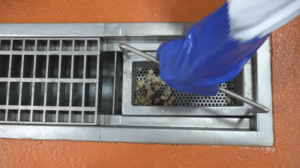
Image Courtesy of: GDT
Installation Details That Protect the Investment
Even the best drainage design can underperform if installation details are overlooked. Successful systems must be designed not only for flow, durability and cleanability, but also for the conditions contractors will encounter during placement, concrete work and floor-finishing activities. Global Drain Technologies treats installation as a design problem in its own right, engineering features that speed the work and prevent errors. Two of those details matter most.
Anchoring Before the Pour
An unanchored trench drain floats in wet concrete and drifts out of level and alignment during the pour. Nobody discovers it until the finished floor will not drain, and by then the fix is cutting the run out and starting again. Global Drain Technologies prevents this with leveling brackets at both ends of every channel section and catch basin. The brackets accept a half-inch reinforcing bar or threaded rod set into the subgrade, held at the chosen elevation by a lock bolt or nuts. Concrete at the base of those rods, cured before the final pour, locks the run in position.
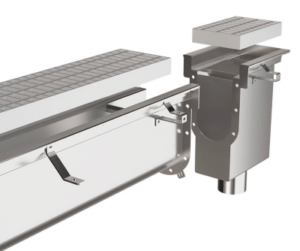
Image Courtesy of: GDT
Protecting the Drain-to-Floor Joint
The second detail helps protect a critical seam at the drain-to-floor interface. Where a resinous floor coating meets stainless steel, a thin feathered edge is vulnerable to cracking under heat, chemicals, and traffic. A keyway, a shallow groove formed in the concrete along both sides of the drain, holds a thicker band of resin there and gives the coating a mechanical grip. Forming the keyway during the pour is faster and more accurate than cutting it afterward.
The Global Drain Technologies KeyForm mounts on the drain beforehand and shapes the groove as the slab sets. The protective cover can also help protect the channel during construction so finished grates may be installed after surrounding trades have completed their work.
Design Drainage as a System
Successful trench drainage depends on a coordinated system of materials, channel geometry, slope, grates, traffic rating, catch basins, strainer baskets, floor interfaces and installation methods. Designing those elements together improves fit, cleanability, predictability and long-term maintainability. Project complexity may vary, but the principle does not. A straightforward commercial washdown area may need a standardized pre-sloped layout, while a processing plant with converging runs, high solids loads and a limited shutdown window may require custom drawings, specialized fabrication and coordinated installation support.
Global Drain Technologies supports projects across that range through modular drainage systems, in-house engineering, custom manufacturing and connections to qualified local installation partners. The goal is not simply to supply a drain, but to help project teams specify a drainage solution that fits the application, integrates with the floor and plumbing design, and performs reliably throughout the facility’s operating life.
When trench drainage is specified as integrated infrastructure rather than a collection of catalog components, it can support efficient operations, safer working conditions, effective sanitation and a lower risk of disruptive repair. The objective is simple: a system that manages flow and solids reliably, protects the floor and plumbing, and allows facility teams to focus on production instead of drainage problems.






