







For a source on affordable and supportive housing, as well as architecture for nonprofits and social service providers, San Francisco-based HCLA brings key insights and a nearly unparalleled depth of experience to the topic.
Setting HCLA apart is the firm’s commitment, made 60 years ago by the founders and activist designers Bob Herman FAIA and Susie Coliver, to “pursue work exclusively within the nonprofit sectors, working as allies to neighborhood-based developers and their advocates.” With partners Steve Rajninger and Melissa Garcia, the architecture and planning firm maintains that ethos to the present day.

Stevenson Terrace by HCLA
Image Courtesy of: Bruce Damonte
This dedication has led to iconic works by the pioneering firm formally known as Herman Coliver Locus Architecture, including the I Hotel and Woolf House, which grew out of the city-wide battles around displacement, demolition and gentrification from the mid-1960s through the early 1980s (photo), and more recently their innovative modular supportive housing at 1064 Mission, below, which took top honors last year for best new building from the Architectural Foundation of San Francisco.
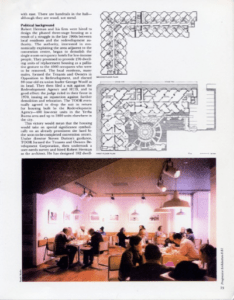
Woolf House as seen in Progressive Architecture Magazine, 1981
Copyrights held by Penton Publishing, Reinhold Publishing and Zonda Media

Interior court at 1064 Mission,
Images Courtesy of: HCLA
“Housing is one of today’s most critical social justice concerns,” says Steve Rajninger FAIA, a principal who has been in practice since 1994 and previously served as leader of the city’s Ronald McDonald House. “I went into architecture specifically with a vision of creating affordable housing, and today the need is greater than ever,” chimes in principal Susie Coliver, who is also an activist, educator, and member of several nonprofit boards.

1296 Shotwell by HCLA
Image Courtesy of: Bruce Damonte
With an interest in sharing their “many lessons learned” with communities and cities beyond their native Bay Area — where some 5,000 housing units bear their welcoming, expressive and even playful signatures — the principals Rajninger and Melissa Iris Garcia, AIA, who is profiled in a new book on Latina architects, are speaking to the media and audiences nationally. Their recent work on multiple permanently supportive housing developments for chronically homeless residents, and on the trials and tribulations inherent in building modular housing in dense urban areas, informs their public presentations and lectures of late.

Historic image of a violent eviction protest at HCLA’s International Hotel in San Francisco, August 4, 1977
Image Courtesy of: Chris Huie, courtesy of the family of Chris Huie
While we continue in our commitment to tackling issues of housing justice in the Bay Area, we have seen how sharing best practices and effective strategies widely can spur better solutions in other communities as well,” says Rajninger, who is known for sharing and speaking broadly about his award-winning designs for those most in need of dignified shelter.
“It’s here at Herman Coliver Locus Architecture that for 26 years I’ve contributed to the firm’s work on behalf of nonprofit clients, fulfilling my goal to serve the community artfully,” Melissa Iris Garcia wrote recently. “This work is all about connecting at a personal level: It is in these depths that we find the cracks in society, and as architects, we have the opportunity to problem-solve.”
To speak with HCLA’s present design leaders and founder Bob Herman, and for imagery and background, contact C.C. Sullivan.






