










Known for parks and plazas that draw people and knit together communities, the award-winning architecture firm EHDD is aiding mayors and city planners nationwide with ideas for reconnecting neighborhoods and public spaces on top of highways that have long divided them.
The idea isn’t new, but legislation calling for “highway lids” — also known as cut-and-cover tunnels or freeway tops, decking, or simply caps — is newly resurgent, for a few reasons. They’re dominating urban planning vision sessions from Texas to Missouri and from Ohio to California, and often come with competing ideas for uses from real estate developers, on the one hand, and from advocates for more housing, public parks and amenities on the other.
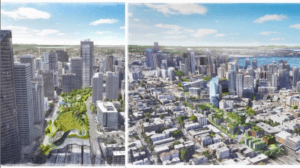
Image Courtesy of: EHDD
Seven decades after the U.S. Interstate program began, there are now 400-plus lidding initiatives underway for various metropolitan areas, by various counts. (New York City alone has considered 83 sites.) In Seattle, a master plan is forthcoming for an initiative to lid Interstate 5, which has been headline news.
“Hundreds of these wide bridge structures built over roadways, which block noise and hide traffic under revived neighborhoods with new urban spaces and parklands, plus more housing, are now in planning or construction,” says Christopher Patano, an advocate for varied “lidding” initiatives in Seattle and elsewhere with EHDD, the architecture firm for the acclaimed Presidio Tunnel Tops in San Francisco. “We’ve championed freeway tops in various forms and, while we’re realistic about the costs and political challenges, their merits are enduring: addressing the damage freeway cuts have done to many neighborhoods, and adding valuable developable land, public amenities and attractions, all while maintaining highway capacity.”
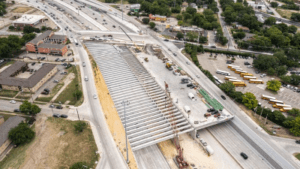
Image Courtesy of: EHDD
NEW VIEW
What’s different today, according to EHDD, is a widely held view of highway lidding as a key to urban renaissance, precisely 70 years after the U.S. Interstate system was launched: a remedy that sparks investment, tourism, and community engagement. The 14-acre Presidio project, led by James Corner Field Operations for landscape design and EHDD as architect — and the winner of this year’s ULI Americas Awards for Excellence — has replaced an elevated highway viaduct with new cut-and-cover tunnels engineered by a Caltrans-led team, which “unlocked the opportunity to reclaim this critical threshold between city, nature, and waterfront as public parkland,” said ULI’s judges. The firm EHDD added, “Presidio Tunnel Tops has welcomed more than seven million visitors annually, with a remarkable 45% increase in the first half of 2024.”
The Seattle I-5 Lid project, currently backed by $2.2 million in funding for expanded feasibility studies, is being integrated into the city’s comprehensive plan.
“What matters most is the investment in public design and architecture, parks, urban amenities and multifamily projects as central to these plans,” says Patano, who has been a catalyst and advocate for the Seattle I-5 plan’s momentum. “The work should embrace nature, integrate new public artworks and learning opportunities, and yield solutions crafted through a highly community-centered process.”
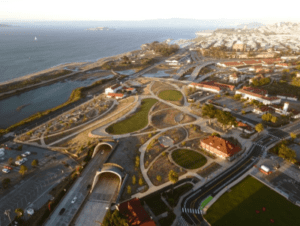
Image Courtesy of: EHDD
Proponents of more lidding include academic researchers, the ULI, and groups such as the Congress for New Urbanism, which published its Freeways Without Futures study last year. Other seminal examples include Klyde Warren Park in Dallas, a 5-acre cap over I-35 credited with adding mixed-use real estate and “igniting significant economic investment and driving surrounding development.” (It also spurred Houston, Austin and El Paso to review their own deck proposals, says the project’s transportation engineer.) Major cities are likely to have a highway lid on the drawing board, with discussions active now in Sacramento, St. Louis, Pittsburgh, and Toronto, among others.
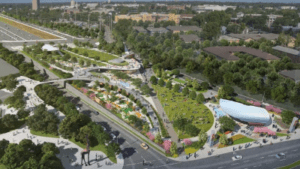
Image Courtesy of: EHDD
EXPERT SOURCE
“Lidding is just one example of what EHDD calls ‘infrastructure for public life,’” says Patano, who publishes and speaks widely on related topics. “Parks are no longer passive green amenities layered onto cities after the fact — they are increasingly functioning as critical civic infrastructure, shaping mobility, ecology, education, resilience, and public life simultaneously.”
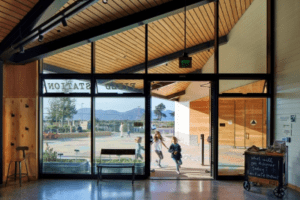

Image Courtesy of EHDD
Images, top to bottom:
I-5 Seattle Lid rendering courtesy City of Seattle’s Office of Planning & Community Development; Southern Gateway Park deck construction photo courtesy SWA; Presidio Tunnel Tops aerial by Andrew Campbell Nelson; Klyde Warren Park in Dallas, courtesy HKS; EHDD-designed Field Station at Presidio Tunnel Tops by Bruce Damonte, courtesy EHDD; Presidio Tunnel Tops sunset by Caitlin Atkinson, courtesy Field Operations.






