









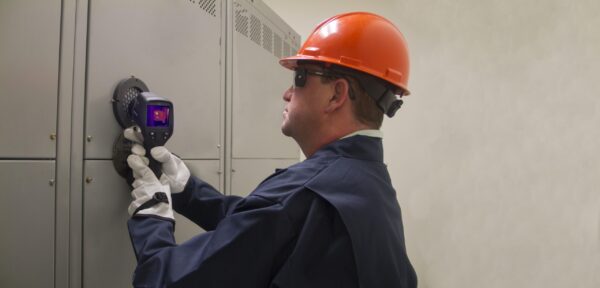
Infrared windows provide thermal inspection access to components inside electrical enclosures while equipment doors and covers remain closed. Their effectiveness, however, depends on more than installing a window wherever space is available. Engineering and maintenance teams must consider what needs inspecting, whether the camera can see it, and how the installation affects the enclosure.
Enclosure compatibility, optical materials, viewing area, infrared transmission, environmental protection, and physical accessibility all influence the quality of an inspection. Addressing these factors during design or retrofit planning helps teams establish repeatable access to critical connections and components.
Start With the Inspection Targets
Before selecting a window, identify the components the maintenance team needs to inspect. These may include cable terminations, busbar joints, breaker connections, fuse connections, and other locations where abnormal heating could indicate a developing problem.
Create an inspection map showing each target and its proposed viewing position. Consider internal partitions, cable routing, insulating barriers, and component orientation. A window facing a breaker does not necessarily provide visibility of its connections.
Infrared inspection requires a suitable optical path to the target surface. Metal barriers and other opaque obstructions can prevent direct observation. Where targets occupy separate compartments or face different directions, multiple windows may be necessary.
The planning question is practical: can the thermographer obtain a useful image of every required target with the enclosure closed?
Check Enclosure Compatibility
An IR window becomes part of the enclosure assembly, so its installation must suit the equipment’s construction and intended service.
Review panel material, thickness, available mounting space, and the clearance required behind the window. Check that the proposed opening avoids structural features, hinges, latches, wiring, and internal equipment. Follow the window manufacturer’s installation requirements and consult the equipment manufacturer about acceptable modifications.
Certification also deserves attention. UL provides certification services for electrical enclosures and accessories, including infrared viewports. However, selecting a certified accessory does not by itself establish that every proposed installation is acceptable. Confirm the conditions of use for the window and the requirements applicable to the enclosure.
Plan installation during an appropriate shutdown, with equipment isolated and verified de-energized under the site’s electrical safety procedures. Cutting and drilling must be controlled to prevent debris entering the equipment.
Select Materials for the Application
IR windows use optical materials that transmit radiation within particular wavelength ranges. Material selection must therefore account for both the inspection environment and the thermal camera.
Crystal and polymer optics offer different combinations of spectral transmission, mechanical properties, dimensions, and environmental resistance. For example, FLIR identifies calcium fluoride as the material used in its IRW windows, while IRISS offers reinforced polymer optics in its VPT and CAP-ENV ranges.
Evaluate the specific product rather than assuming all crystal or polymer windows behave alike. Relevant considerations include operating temperature, impact resistance, chemical exposure, cleaning requirements, and compatibility with the camera’s spectral response.
Visible transparency is a separate consideration. If technicians also need to read labels or examine components visually, confirm that the selected optic supports that task. A material’s ability to transmit visible light does not establish its suitability for thermal imaging.
Match Viewing Area to Inspection Coverage
The window’s external dimensions do not describe its usable viewing aperture. Frames, seals, and reinforcing structures can reduce or interrupt the available optical path.
Inspection coverage depends on the aperture, target depth, camera lens, and camera position. A larger window can provide more positioning flexibility, but it cannot remove internal obstructions or guarantee that every component is measurable.
Camera resolution matters too. A small connection may appear in an image without occupying enough pixels for dependable temperature measurement.
Before finalizing locations, validate the proposed arrangement using equipment drawings, a mock-up, or an assessment during a planned outage. Check the actual camera and lens wherever possible.
Account for Infrared Transmission
An IR window does not transmit all the infrared radiation reaching its surface. Temperature measurements must account for the window’s transmission characteristics.
Where supported, the camera’s external optics settings allow the thermographer to compensate for transmission losses. This adjustment is separate from target emissivity; one should not be substituted for the other.
There are several factors that can affect effective transmission, including the camera’s response, target temperature, viewing angle, contamination, and optic condition. Follow the manufacturer’s guidance and verify the compensation method for the intended measurement conditions.
For repeatable inspections, document the window identification, camera settings, viewing position, and equipment loading. Inspect the optic for contamination or damage before collecting data. Consistent access and recorded conditions make comparisons between inspections more meaningful.
Preserve Environmental Protection
The window assembly must suit the enclosure’s exposure to dust, moisture, washdown, corrosion, and temperature extremes.
Check the complete assembly, including its frame, gasket, fasteners, and protective cover. Confirm whether the stated protection depends on the cover being closed and whether that protection changes during inspection.
Installation quality is equally important. Incorrect cutouts, damaged seals, unsuitable mounting surfaces, or improper fastening can compromise the intended protection.
Make Access Practical and Repeatable
Finally, consider the thermographer’s working position. Windows should be accessible without nearby equipment, pipework, or structural features obstructing the camera. Allow space to open protective covers, position the lens, and identify each inspection point.
Record inaccessible targets as inspection limitations rather than assuming the window provides complete coverage.
Effective thermal inspection access brings enclosure design and maintenance requirements together. When teams plan around specific targets, verify optical performance, and preserve the enclosure’s intended protection, IR windows can support consistent condition-based maintenance decisions.
Feature Image Courtesy od IRISS






