










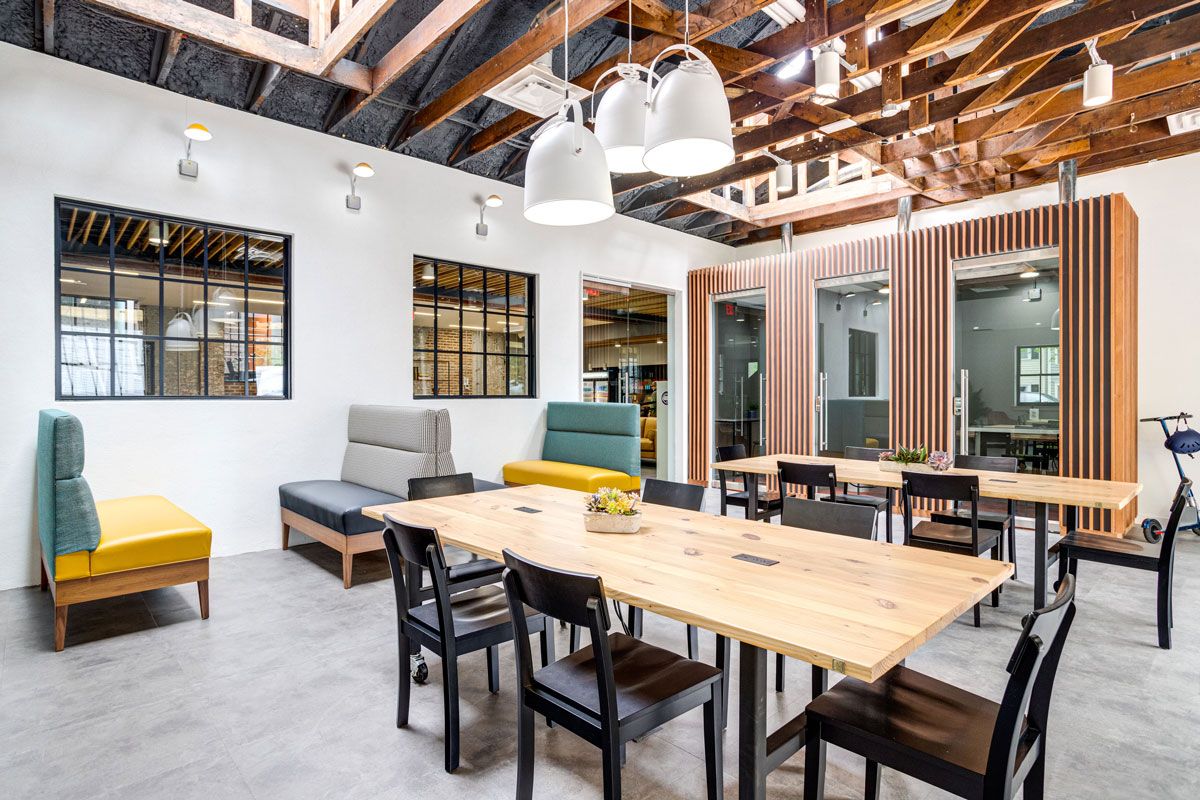
The office has a new job description. Once designed primarily around desks, conference rooms and daily routines, today’s workplace is increasingly becoming a destination for collaboration, customer engagement and company-wide events. For businesses navigating hybrid and remote work, the challenge is creating spaces that give employees and visitors a compelling reason to walk through the doors.
At the Airline Tariff Publishing Company‘s (ATPCO) new 20,600-square-foot headquarters in Herndon, Virginia, that vision is taking shape.
Designed by OTJ Architects and built by Pizzano Contractors, the facility combines flexible meeting spaces, hospitality-inspired amenities and technology-enabled environments. Together, these elements create a headquarters that serves as both an everyday workplace and a destination for company events.
The project reflects a broader evolution in commercial construction, where sophisticated interiors, changing workplace expectations and increasingly complex building systems are placing greater demands on contractors.
We sat down with Will Pizzano, Director of Preconstruction, to discuss the changing role of the office, lessons from the ATPCO project and how nearly seven decades of experience are helping the company navigate what’s next.
How is the changing role of the office reshaping what companies expect from their workplaces?
Dramatically. People are not simply comparing one office to another anymore. They’re comparing the experience of being in the office to that of working from home.
That means the spaces we’re building today need to be comfortable, flexible, technologically integrated and worth coming to. We’re seeing greater emphasis on collaboration spaces, hospitality-driven amenities, acoustics, wellness, fitness, food and beverage, and spaces that create community.
We’re also seeing a continued flight to quality. Companies may occupy less space than they did historically, but the spaces tend to be more intentional and sophisticated.
As a contractor, good preconstruction is understanding what matters most to the client and helping them spend their money in the places that have the greatest impact.
How does ATPCO’s new headquarters reflect this evolution?
ATPCO is a remote-first organization with employees spread across the country and the world. Its new headquarters needed to do more than accommodate people coming into the office on a typical workday.
Working alongside ATPCO and OTJ Architects, we transformed a white-box shell into a 20,600-square-foot headquarters designed to support focused work, collaboration, customer meetings, executive gatherings and company-wide events.
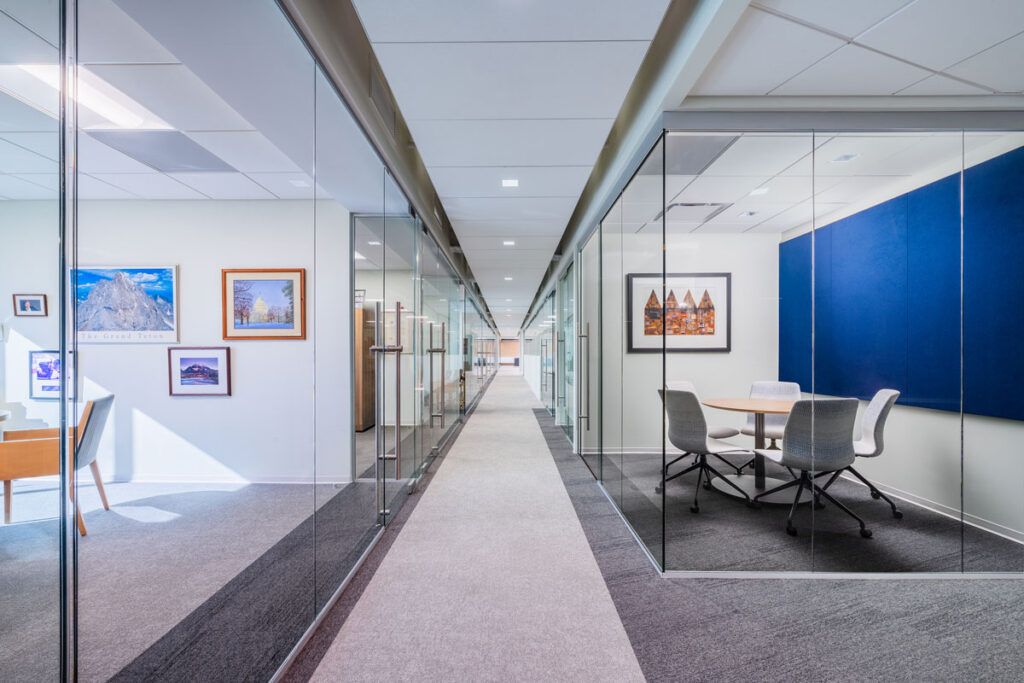
The project includes quiet focus rooms, technology-enabled collaboration areas and flexible conference spaces with operable glass partitions that can expand or contract depending on the size of a gathering.
There are also wellness and prayer rooms, an open pantry that serves as a social center and aviation-inspired architectural elements that connect the space to ATPCO’s identity. The expansive views overlooking Washington Dulles International Airport reinforce that connection.
The objective was to create a headquarters that could support the company’s everyday needs while becoming a place where employees, customers and leadership could come together.
 What changes when an office must also function as an event venue?
Flexibility becomes much more important, but it has to be considered from the beginning. You cannot simply create a large conference room and assume it will accommodate every type of gathering.
The space must support different activities, different group sizes and different technology requirements. A room that works for a small leadership meeting may also need to accommodate a much larger event with both in-person and virtual participants.
That affects everything from the physical layout and building systems to scheduling and construction coordination.
At ATPCO, the flexible conference spaces, multipurpose areas and social pantry allow the headquarters to transition between everyday work and larger gatherings without requiring major changes to the physical environment.
From a construction standpoint, the important thing is understanding how the client intends to use those spaces. The earlier the contractor, architect, client and consultants begin solving those challenges together, the better the outcome tends to be.
The ATPCO project presented some unexpected construction challenges. How did your team respond?
One of the biggest challenges is that schedules continue to get shorter while projects become more technically complicated. We’re often working in existing buildings where conditions are not always fully documented. You have to understand where the risks are and communicate them honestly.
At ATPCO, unforeseen slab conditions discovered early in construction required extensive floor preparation and adjustments to the sequencing of work.
Rather than allowing that issue to disrupt the overall schedule, our team worked closely with our trade partners to phase the grinding and floor preparation around other ongoing activities. This allowed construction to continue while we addressed the conditions.
It is a good example of why we place so much emphasis on preconstruction and communication. We would much rather have a difficult conversation during preconstruction than an expensive conversation six months later.
Our goal is not to pretend uncertainty does not exist. It is to expose it early enough that the project team can make the best decisions around it.
One of ATPCO’s most important milestones came before its headquarters was finished. How did you accommodate that?
ATPCO needed its approximately 500-square-foot boardroom operational for a scheduled Board of Directors meeting, even though construction was continuing throughout the rest of the headquarters.
Our team reprioritized and accelerated that portion of the project, allowing us to turn over the boardroom approximately two months ahead of substantial completion.
That’s where understanding the client’s business objectives becomes especially important. A construction schedule cannot always be viewed as one finish line.
Sometimes a client has a critical meeting, an event or another business milestone that cannot move. You have to understand those priorities and determine how to sequence the work to accommodate them.
What does the completed ATPCO headquarters say about the value of creating a workplace destination?
The results demonstrate what can happen when a headquarters is designed around the way a company actually wants to work and engage with people.
ATPCO’s previous office averaged approximately 15 employees per week between 2020 and 2025. Since the new headquarters opened, many weeks have seen more than 50 employees working from the office, even as the percentage of employees living within 25 miles of the headquarters has declined significantly.
The facility has also become a destination for company events. Its December 2025 grand opening coincided with ATPCO’s 60th-anniversary Gala, bringing employees from Canada, London, Singapore, Australia and across the U.S. together.
Since then, the headquarters has hosted executive summits, customer visits and internal gatherings, helping reduce expenditures associated with nearby hotels and event facilities.
The common denominator in many of today’s projects is complexity. Whether you are dealing with challenging existing conditions, tight schedules, significant MEP coordination, demanding design or multiple stakeholders, strong preconstruction and communication are essential.
With schedules tightening and project complexity increasing, how are contractors adapting their approach to preconstruction and project management?
Clients understandably want cost certainty very early in the process, often before the design is fully developed. At the same time, contractors are renovating older buildings with incomplete documentation, working around occupied tenants and coordinating sophisticated mechanical and electrical systems.
This puts a premium on experienced preconstruction. You must identify the unknowns, understand where the risks are and communicate those risks honestly.
The earlier you can identify potential issues, the more options everyone has to address them without compromising the project’s objectives.
How important are relationships and early collaboration in helping contractors navigate today’s construction challenges?
Construction is still fundamentally a relationship business. The earlier the contractor, architect, client and consultants begin solving problems together, the better the outcome tends to be.
We work closely with building owners, developers, corporations, architects, brokers, project managers and tenant representatives. Many of those relationships become long-term partnerships. Take our relationship with Covington, which extended more than 30 years. Through that relationship, we came to know Alfred Moses and Gene Ludwig.
When they established Promontory Interfinancial, they brought Pizzano with them, and we ultimately built Promontory’s headquarters in Washington, D.C. Those relationships continued into other projects and organizations.
 Beyond workplace design, what emerging trends are creating new opportunities for commercial construction contractors?
Adaptive reuse is a major one, particularly in Washington, D.C. We have a tremendous amount of existing commercial real estate that needs to evolve, whether that means repositioning an office building, converting it to another use or dramatically upgrading the tenant experience.
Sustainability is also becoming less of a standalone initiative and more of an underlying expectation. Because so much of our work involves renovation and repositioning, sustainability often starts with reusing an existing building rather than replacing it.
We’re working with owners and design teams to reuse existing infrastructure where practical, improve building systems, reduce energy consumption and select materials and equipment with longer useful lives.
We’re also seeing greater emphasis on energy efficiency, indoor environmental quality, electrification, responsible material selection and construction waste management.
How are today’s commercial construction contractors incorporating technology and artificial intelligence (AI) to improve efficiency, decision-making and project outcomes?
Technology is becoming increasingly important to how contractors manage information, evaluate risk and make decisions. Better data, reality capture, automated estimating, AI and increasingly connected project management systems are going to change how contractors operate.
AI is particularly interesting to us. We’re beginning to explore applications such as RFP review, scope-gap identification, historical cost analysis, proposal development and capturing lessons learned from completed projects.
I do not think technology replaces construction experience. I think it allows experienced people to spend less time processing information and more time making good decisions.
As client expectations and industry demands continue to evolve, how must commercial contractors position themselves for long-term success?
The workforce is going to be a major consideration. Construction continues to become more technically sophisticated, and we need talented people at every level, from skilled tradespeople in the field to estimators, project managers and superintendents.
Cost predictability is another challenge. Owners are making major investment decisions earlier than ever, and contractors need better historical data and systems for turning limited information into reliable budgets.
Our industry also needs to improve the way information moves between everyone involved in a project. Construction produces an enormous amount of valuable knowledge that too often disappears when a project ends.
Pizzano is investing in its people, systems and technology while continuing to strengthen its preconstruction capabilities. We want to take on increasingly sophisticated projects while preserving the relationships, accountability, accessibility and culture that have made our company successful for nearly 70 years.
Ultimately, our reputation comes down to how we treat people and how we respond when challenges arise. The best thing a client can tell us is, “We want you on the next one.”






