









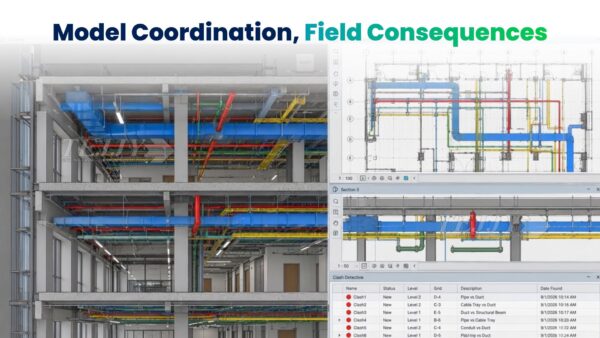
Fast-track schedules put pressure on every phase of a project. Something has to give. Too often, that something is the constructability review, even though teams offering constructability review consulting are built specifically to work inside compressed schedules, not against them. The design is done. The team is ready to build. Skipping this step looks like a safe cut. The answer shows up later. It shows up in the RFI log.
The RFI Problem Hiding in Fast-Track Schedules
Every RFI has a cost. Some are minor. A quick clarification. A confirmed dimension. Others stop work. A crew waits on an answer. A trade resequences. A schedule slips.
Most of these RFIs are preventable. They trace back to conditions that were never checked before construction started. A constructability review exists to catch exactly this kind of problem early, while it is still cheap to fix. Skip the review, and those same problems surface in the field instead. By then, they cost more to fix. They also cost time nobody budgeted for. A schedule built around a fixed sequence has no slack for a mid-construction surprise.
What a Constructability Review Actually Catches
A constructability review is not a second design pass. It is a targeted check on whether the design can actually be built as drawn.
A typical review looks for:
- Clash conditions between systems- mechanical, electrical, plumbing, and structural elements competing for the same space
- Sequencing conflicts across trades- work that assumes an order the schedule cannot actually support
- Specifications that read fine on paper but create conflicts once installed in the field
- Dimensional and tolerance issues- clearances, access points, and equipment paths that look workable in 2D but fail in real conditions
- Code-driven clearance requirements that get missed when reviewed in isolation from field sequencing
None of this requires redesigning the project. It requires someone qualified to walk through the model or drawings with construction sequencing in mind, before crews mobilize. The review adds a construction-first lens to a design that was, until that point, only ever tested against design intent.
This distinction matters more than it sounds. A design can satisfy every code requirement and still be difficult to build efficiently. Constructability review exists specifically to close that gap, before it becomes someone else’s problem in the field.
The Real Cost of Skipping a Constructability Review on Commercial Projects
Cost comparisons across project types tell a consistent story. Projects that skip a constructability review generate a higher volume of RFIs during construction. Many of those RFIs relate to conditions a review would have caught. The RFI math on skipped constructability reviews breaks this pattern down by project type in more detail.
| Project Type | Common Clash Point | Field Impact If Missed |
| Commercial | MEP coordination above ceilings | Rework, resequenced trades |
| Institutional / Healthcare | Code-driven clearances, equipment access | Inspection delays, change orders |
| Federal | Submittal alignment with agency standards | Resubmittal cycles, schedule slippage |
| Semiconductor / Mission-critical | Tight equipment tolerances | Little to no field improvisation room |
Commercial projects see this most often in MEP coordination. Institutional and healthcare projects see it in code-driven clearances and equipment access. Federal projects see it in submittal rework, where a design that passes internal review still fails to meet agency requirements once construction starts.
Semiconductor and mission-critical facilities raise the stakes further. Equipment tolerances leave almost no margin for field improvisation, so a missed clash there rarely stays a minor fix.
The pattern holds across all three: a review skipped early becomes a delay paid for later, at a higher rate than the review itself would have cost. The delay rarely stays contained to one trade. A single unresolved clash can hold up downstream work across multiple crews, compounding the schedule impact well beyond the original conflict.
Why Teams Still Skip Constructability Reviews on Fast-Track Schedules
The reasoning is understandable. A constructability review takes time upfront. Fast-track projects are defined by not having that time.
There is also a perception problem. Teams already invest in design review. A constructability review can look like a duplicate step, not an additional layer of protection.
Budget pressure reinforces the same instinct. Every added review looks like added cost, at least on paper. What that view leaves out is the cost already baked into the schedule for RFIs, resequencing, and rework that a review would have prevented. It isn’t a duplicate. Design review confirms the design meets intent. Constructability review confirms the design can be executed as intended, under real field conditions, by the trades actually building it. One checks the drawing. The other checks the jobsite the drawing is about to meet.
How Model-Based Constructability Review Changes the Outcome
BIM-based constructability review changes the economics of this decision. A coordinated model surfaces clashes, sequencing conflicts, and access issues before a single RFI gets written.
This is where a constructability review earns its place in a fast-track schedule rather than competing with it. Because it operates on the model directly, it does not require the design team to slow down. It runs in parallel, catching field-level conflicts while the design is still finalizing.
Teams that bring this review in early are not just avoiding rework. They gain a clash-checked model they can hand straight to the field team, cutting the back-and-forth that normally happens once construction starts. The result is a shorter RFI log once construction starts. Fewer stop-work conditions. Fewer trades waiting on answers that could have been resolved before mobilization.
The Bottom Line on Constructability Review ROI
A constructability review does not remove risk from a project. No review does. What it does is move risk to the point where it is cheapest to resolve.
Skip it, and that risk does not disappear. It resurfaces mid-construction, as an RFI, a delay, or a change order. Fast-track schedules cannot afford to absorb that kind of surprise. The teams that build in a constructability review are not adding time to their schedule. They are protecting the time they already have. On a compressed timeline, that protection is the difference between holding the schedule and rebuilding it mid-project.
______________________________________________________________________________
Author:
Preetie Singh is the Founder and CEO of Tejjy Inc., an 8(a)-certified and women-owned design-build firm. She brings decades of leadership experience in the AEC industry, with a focus on BIM-enabled operational efficiency and technology-driven project management. She is also a strong advocate for closer coordination between construction and facility management teams.
Feature Image : Courtesy of Tejjy Inc






