









Research and post-storm lessons are changing how resilience is built into commercial properties
Ross Haigler, Senior Director of Commercial Lines, Insurance Institute for Business & Home Safety
Decades of research and post‑storm investigations now make it clear where commercial buildings fail in hurricanes; those insights are reshaping how the industry designs and builds for resilience. Commercial buildings face a variety of risks during hurricanes. High winds, wind-borne projectiles, wind-driven rain, inland flooding and extended power outages can damage building systems. This results in closures, damaged inventory, and disrupted operations long after the storm passes. That reality is driving building owners, developers, and contractors to place greater emphasis on building performance in design, construction, and renovation decisions.
In response, commercial buildings are being designed and built differently in hurricane-prone regions. Those changes are increasingly shaped by what recent storms have revealed: where buildings fail. From roof systems and exterior features to flood-exposed equipment and drainage capacity, lab-based research and post-storm assessments highlight these patterns. Those insights are driving a shift toward more continuous load paths from roof to foundation, wider use of impact-rated materials, and design decisions that improve building performance. The result is an industry-wide move beyond structural survival to a more comprehensive focus on how buildings withstand storms and support faster recovery.
Where Buildings Fail Most Often
Damage in commercial buildings during hurricanes often begins at a small number of predictable failure points, primarily in roofs, doors, and windows. This makes routine building inspection and maintenance critical to preserving the structure’s performance.
Even relatively minor roof damage can allow wind-driven rain to enter a building, leading to interior damage of property and contents, and eventually business interruption challenges. As a result, inspecting and repairing roof coverings, securing roof-mounted equipment, maintaining flashing, and ensuring roof and site drainage systems are clear of debris helps keep buildings intact and operational.
Openings are another critical point of exposure. When doors fail, internal pressurization can worsen damage throughout the building. Whether personnel or overhead doors, they should be properly anchored to the structure, free of significant corrosion, damage or warping, and rated for wind loads and impact appropriate to the area.
Conditions on the property, outside of the building structure, are also critical elements to consider. Unsecured items—from signage to equipment—can become wind-borne hazards. Trimming trees, inspecting sign connections, and securing or relocating movable items before a storm helps reduce the risk of impact damage to buildings and nearby properties. These vulnerabilities rarely occur in isolation—failure in one area can quickly trigger issues elsewhere. This cascading effect is an example of a damage amplifier, where the failure of a single component leads to broader impacts across the structure. Because these failures are predictable, routine inspections and targeted maintenance can prevent avoidable hurricane‑related losses.
Fixing One Component Isn’t Enough: The System Approach
Addressing these failure points individually is not always enough. There is growing emphasis on strengthening the exterior features of a building as an integrated system where all of the components work together to resist wind and water intrusion. When these components are aligned, buildings are better able to maintain their integrity during a storm and avoid the cascading damage that leads to extended disruptions.
As this system-level approach evolves, it is increasingly supported by standardized evaluation tools used in the field. These frameworks focus on critical components such as roof systems, drainage, openings, rooftop equipment, and flashing—areas that consistently drive damage in post-storm assessments—and provide a consistent way to assess performance and identify vulnerabilities. For design and construction teams, this creates a clearer path to building resilience into projects from the outset, rather than addressing issues after they occur.
Some of these approaches are now being formalized into building codes and construction standards designed to address the most common points of failure in commercial buildings. One example is the FORTIFIED Commercial standard, a beyond-code framework developed through building science research for improving resilience in light- to moderate-scale commercial buildings. It reflects a shift toward designing buildings that not only meet minimum requirements but are intentionally constructed to withstand extreme wind and rain as a system.
From Failure Points to Performance by Design
Where buildings break in hurricanes is no longer a mystery. What is changing is how the industry responds, applying those lessons to the way buildings are designed and constructed. As materials, connections and system-level approaches continue to evolve, the industry is moving toward buildings that are intentionally designed to perform under extreme wind, rain and flood conditions. For designers and contractors, that shift represents not just an evolution in standards, but a new baseline for resilient commercial construction. The industry now has the knowledge and the tools to build commercial structures that stay operational after hurricanes. The next step is making resilience the standard, not the exception.
Commercial Roller Doors
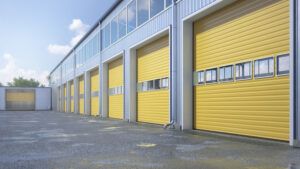
Roller doors must be structurally sound and properly wind-rated. Failure can lead to internal pressurization and increased damage throughout the building.
Roof-mounted Equipment
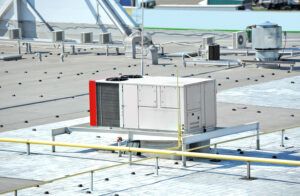
Securing and maintaining roof-mounted equipment helps prevent small roof vulnerabilities from becoming larger failures during hurricanes.
Loose Items on Property
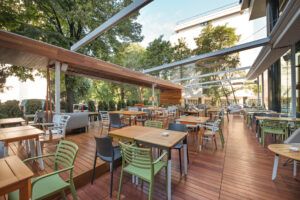
Securing or relocating loose items, such as patio furniture, before a storm helps prevent small issues from escalating into larger, cascading damage.
Images Courtesy of https://ibhs.org/




