










Buying your first home is exhilarating—you’re finally choosing paint colors, arranging furniture, and making a space truly yours. But amid the excitement of move-in day, it’s easy to overlook crucial details that affect your home’s comfort, security, and energy efficiency. Your entry door is one of those details. It seems straightforward enough: pick something attractive, install it, and you’re done. In reality, entry doors involve considerations around insulation, security, sizing, and long-term durability.
Many first-time homeowners discover these complexities only after making costly mistakes. This guide walks you through the most common entry door missteps and how to avoid them, so you can make informed decisions that protect your investment.
Mistake #1: Choosing Style Over Substance
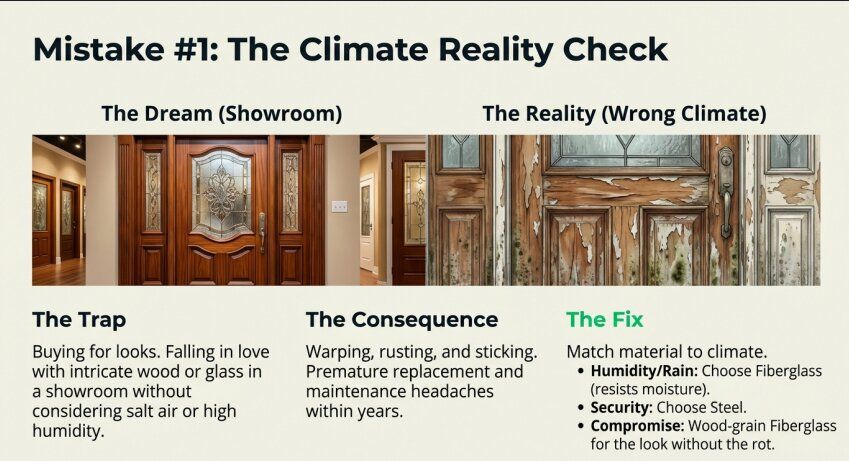
The mistake: Falling in love with a door’s appearance without evaluating whether it can withstand your climate or meet your functional needs.
Why it happens: When browsing showrooms or online galleries, first-time buyers naturally gravitate toward doors that enhance curb appeal. A gorgeous wood door with intricate glass panels catches the eye, but it might not be the best choice for a coastal home facing salt air and humidity.
The consequence: Doors that look stunning in the showroom can warp, crack, or fade within a few years if they’re not suited to your environment. Wood doors in humid climates may swell and stick. Steel doors in coastal areas can rust. Suddenly, that beautiful entrance becomes a maintenance headache and a financial burden as you face premature replacement.
The fix: Match your door material to your local climate conditions. Fiberglass doors resist moisture and work well in humid or rainy regions. Steel doors offer excellent security and durability in moderate climates. If you love the look of wood, consider fiberglass doors with wood-grain finishes that deliver aesthetics without the maintenance. Always ask about the recommended climate zones for any door you’re considering, and research what maintenance the material requires over time. The right door balances beauty with practicality.
Mistake #2: Incorrect Measurements and Sizing
The mistake: Assuming all doors come in standard sizes or taking quick measurements without accounting for the door frame, rough opening, and clearance requirements.
Why it happens: First-time homeowners often lack experience with construction terminology and don’t realize that “door size” can refer to different measurements—the door slab itself, the frame, or the rough opening in the wall.
The consequence: Ordering a door based on incorrect measurements leads to frustrating scenarios. Gaps between the door and frame compromise both insulation and security, letting in drafts and potentially making your home vulnerable. If the door is too large, you’ll face expensive returns, restocking fees, or the cost of custom modifications. If it’s too small, you’ll need additional framing work. Either way, you’re looking at installation delays and unexpected expenses.
The fix: Measure carefully at multiple points, since older homes especially may have settling or non-square openings. Record the height and width at the top, middle, and bottom of the opening. Measure the depth to ensure the door and frame will fit your wall thickness. Account for door swing—will it clear stairs, railings, or furniture? Don’t forget to distinguish between rough opening measurements and actual door dimensions. When in doubt, consult with professionals who can guide you through the process. Retailers like Doornmore provide sizing guidance to help you get accurate measurements from the start, reducing the risk of costly ordering mistakes.
Mistake #3: Overlooking Insulation and Energy Efficiency
The mistake: Selecting an entry door based on appearance and price without checking its R-value, weatherstripping quality, or energy efficiency ratings.
Why it happens: Energy performance isn’t something you can see or touch in a showroom. Unlike the color or style, insulation quality requires reading specifications and understanding technical ratings—details that first-time buyers may not know to look for.
The consequence: A poorly insulated door turns your entryway into a major source of energy loss. You’ll feel drafts every time you walk past. Your heating and cooling systems will work harder to maintain comfortable temperatures, driving up your utility bills month after month. Over the life of the door, these costs add up significantly. You’ll also experience comfort issues—cold spots in winter, heat infiltration in summer—that make your home less enjoyable.
The fix: Prioritize doors with high R-values, which measure thermal resistance. The higher the R-value, the better the insulation. Look for ENERGY STAR certified options that meet strict efficiency guidelines. Examine the weatherstripping and threshold seals—these components prevent air leakage around the door’s perimeter. Quality weatherstripping should be resilient and continuous with no gaps. <a href=”https://www.doornmore.com/exterior-door-1/”>Retailers such as Doornmore highlight insulation specifications</a> and energy ratings, making it easier to compare options side by side. Investing in an energy-efficient door pays dividends through lower utility costs and improved home comfort for years to come.
Mistake #4: Skimping on Security Features
The mistake: Choosing hollow-core doors or basic lock systems to stay within budget, without considering the security implications.
Why it happens: Budget constraints are real for first-time homeowners juggling mortgage payments, furniture purchases, and unexpected repairs. Security features can seem like optional upgrades rather than necessities, especially in neighborhoods that feel safe.
The consequence: Hollow-core doors can be kicked in with minimal force, making your home an easy target for break-ins. Basic locks without deadbolts provide little resistance to determined intruders. Beyond the immediate safety risk, inadequate security can affect your homeowner’s insurance rates or coverage. Some policies require specific security measures, and a weak entry door could mean higher premiums or denied claims.
The fix: Invest in solid-core or reinforced doors that can withstand forced entry attempts. Steel or fiberglass doors with solid cores offer excellent security. Upgrade to deadbolts with at least a one-inch throw, which extends deep into the door frame. Consider smart lock compatibility if you want remote access control and activity monitoring. Remember that door security isn’t just about the door itself—verify that the frame is equally strong and properly reinforced. The lock is only as good as what it’s anchored into.
Mistake #5: DIY Installation Without Proper Skills
The mistake: Attempting to install an entry door yourself to save on labor costs, despite lacking the experience or tools to do it correctly.
Why it happens: Installation fees can run several hundred dollars, and first-time homeowners often look for ways to reduce expenses. Online tutorials make the process look manageable, and there’s satisfaction in completing home improvements yourself.
The consequence: Entry door installation is more complex than it appears. Improper hanging leads to doors that don’t close correctly, creating gaps that compromise insulation and security. Poor alignment can cause the door to stick, drag, or not latch properly. Inadequate sealing allows air and moisture infiltration. Many manufacturers void warranties if the door isn’t installed by a certified professional, leaving you without recourse if problems develop.
The fix: Be honest about your skill level and the tools you have available. Professional installers bring experience, specialized tools, and knowledge of local building codes. They ensure proper alignment, sealing, and hardware installation. When budgeting for a new door, factor professional installation into the total cost from the beginning. Ask what the installation includes—hardware mounting, weatherstripping, threshold adjustment, and finishing touches. The money spent on professional installation protects your larger investment in the door itself and ensures it performs as intended.
Mistake #6: Ignoring Local Building Codes and HOA Requirements
The mistake: Purchasing and installing a door without researching municipal building codes or homeowners association architectural guidelines.
Why it happens: In the excitement of customizing your new home, it’s easy to focus on personal preferences without considering regulatory requirements. Building codes and HOA rules may not be top of mind for first-time homeowners.
The consequence: Non-compliant doors can result in failed inspections, mandatory removal, fines, or forced modifications. Some jurisdictions have specific requirements for fire ratings, particularly for doors near garages or in multi-family buildings. HOAs may restrict colors, styles, or materials to maintain neighborhood aesthetics. Discovering these issues after installation means you’ll pay twice—once for the door you wanted and again for the compliant replacement.
The fix: Before shopping, research your local building codes, particularly regarding fire ratings and egress requirements. Contact your municipality’s building department if you have questions. If you live in a community with an HOA, review the architectural guidelines and submit your plans for approval before purchasing. Obtain any necessary permits before installation begins. This upfront research takes minimal time but prevents expensive mistakes and legal complications.
Mistake #7: Forgetting About Hardware and Accessories
The mistake: Budgeting only for the door itself without accounting for the hardware, accessories, and finishing touches needed to complete the installation.
Why it happens: When you see a door priced at a certain amount, it’s natural to assume that’s the total cost. The smaller components—hinges, locks, handles, kick plates, and decorative elements—aren’t always included or prominently displayed in pricing.
The consequence: You may find yourself unable to complete the installation because you lack essential hardware. Alternatively, you might end up with mismatched components that detract from your door’s appearance or functionality. Budget overruns at this stage can be frustrating when you thought the project was nearly complete.
The fix: Create a comprehensive budget that includes hinges rated for your door’s weight, quality locksets and deadbolts, handles or handlesets in finishes that coordinate with your home’s exterior, kick plates to protect the door’s bottom edge, and door viewers or peepholes. Don’t forget that weatherstripping may need periodic replacement. Account for these items upfront, and consider purchasing hardware packages that ensure all components match and work together seamlessly.
How to Avoid These Mistakes
The common thread running through these mistakes is inadequate preparation. First-time homeowners can avoid these pitfalls by approaching their entry door purchase methodically. Research thoroughly using resources from established retailers who provide detailed specifications and buying guides. Ask questions—don’t hesitate to leverage the expertise available from companies like Doornmore and other specialists who work with entry doors daily.
Create a comprehensive checklist covering security features, insulation ratings, precise sizing, complete budgeting, and code compliance. Plan for the long term by considering how the door will perform over its 10-plus-year lifespan, not just how it looks on installation day. Finally, don’t rush the decision. Take time to compare options, gather information, and make choices you’ll be confident about for years to come.
Conclusion
Your entry door is far more than a decorative element—it’s a significant investment in your home’s security, energy efficiency, and value. While first-time homeowners face a learning curve with many aspects of home ownership, the mistakes outlined here are entirely avoidable with proper planning and research. By understanding the importance of material selection, accurate sizing, insulation quality, security features, professional installation, code compliance, and complete budgeting, you can make informed decisions that serve you well for decades. Research thoroughly, consult with experts, and prioritize quality over quick fixes. The right entry door enhances both your home’s value and your daily comfort, providing peace of mind every time you turn the key.




