










Is it possible to develop a world-class rail travel system in the United States? From a design and construction perspective, challenges abound — including the need for entirely new high-speed networks, better rail connections at airports and the implementation of “through-running” capabilities that turn dead-end terminals into more effective transit waypoints.
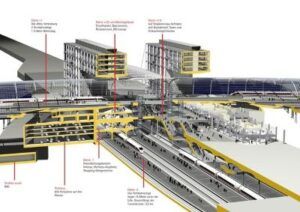
Image Courtesy of: gmp Architects
Drawing on experience in dense cities and across entire regions worldwide, the firm gmp Architects and its leaders — including transit expert Tobias Keyl — have shown how a blend of innovative thinking and technical acumen can help overcome these and other frequent constraints. Brought to worldwide attention with the Renaissance of Railway Stations exhibition at the 6th Architecture Biennale in Venice in the 1990s, over the ensuing decades gmp has delivered dozens of efficient and architecturally significant rail projects, highlighting the firm’s expertise in railway planning and commitment to shaping the future of urban transport hubs.
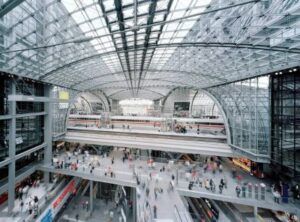
Image Courtesy of: gmp Architects
U.S. experts are increasingly taking note, as Keyl and his colleagues speak to officials and audiences nationwide like the Mineta Transportation Institute (MTI). Over several decades gmp has delivered transformative rail projects including Berlin Central Station, recognized as the largest railway intersection in Europe, and numerous pioneering East Asian high-speed rail hubs — leading the California-based MTI to state that gmp has “redefined large-scale infrastructure.”
Image Courtesy of: gmp Architects
For insight on these influential projects, the strategies behind them, and their applicability in North American contexts, gmp’s Tobias Keyl is available as a media resource with valuable experiences to share. An associate partner at the firm who serves on transit advisory groups at the Harvard University Graduate School of Design and has lectured in California on “Rail Stations to Connect the World,” Keyl is highly regarded for expertise on key topics, including:
- Airport integration with regional rail lines to minimize environmentally harmful short-haul flights, a goal achieved by extending rail platforms directly beneath airport terminals to provide highly efficient, single-transfer connections from plane to train, as at gmp’s Frankfurt and Berlin Brandenburg Airport projects.
- Planning and design strategies supporting the conversion of dead-end terminals into through-running stations, which facilitate better connections across regional rail networks and allow for greater train frequency by eliminating the need for trains to reverse direction outside the city center. Keyl notes that this issue presented a core challenge for many European cities with historic rail infrastructure, with gmp contributing to numerous successful conversions across Germany and beyond. Keyl also notes the benefits of leveraging new high-speed rail networks to facilitate mixed-use development and offset engineering and construction costs, for example by moving tracks and station concourses underground to enable dense urban development above.
- Innovative solutions for centralizing municipal transit services and regional and national rail services within bright, uplifting civic hubs. gmp’s design for Berlin Central Station (image above) is a seminal example of this approach, with its “flying crossover” that places regional rail lines perpendicularly above an existing municipal subway and utilizes massive voids and a fully glazed roof over the main hall to bring daylight all the way down to the lowest platforms. gmp has employed similar design strategies across major cities worldwide, most recently at the recent Beijing Fengtai Station, a three-level transit hub completed in 2022.




