








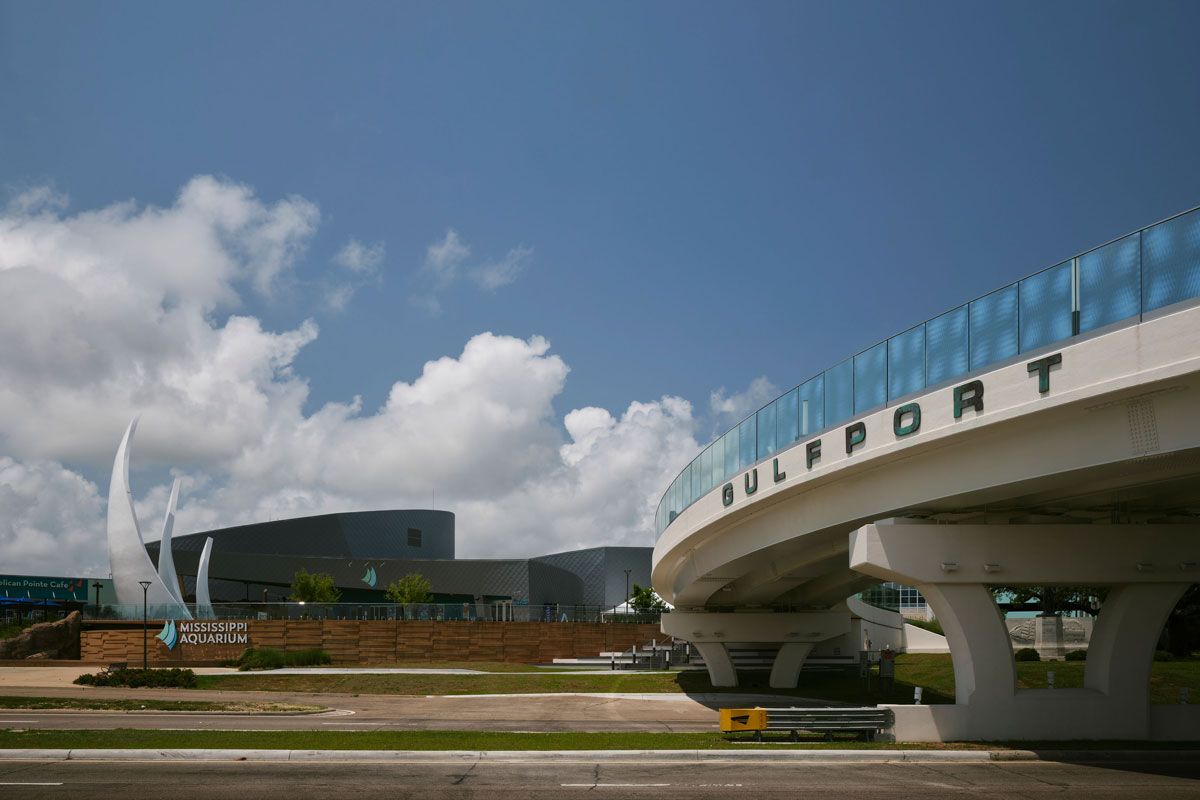
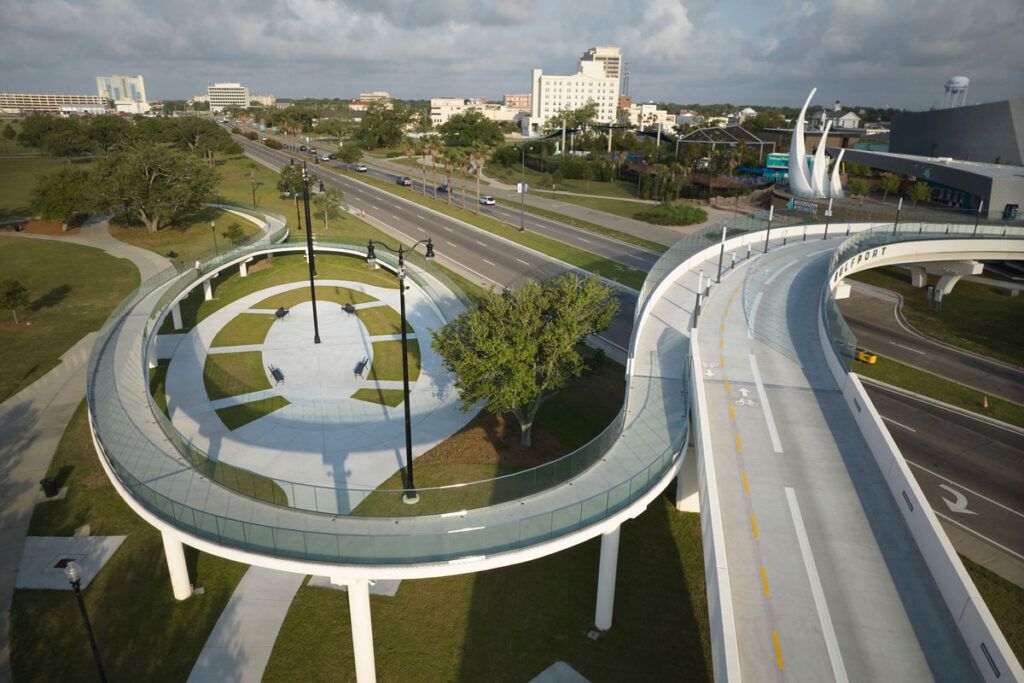
In February 2024, the City of Gulfport, Mississippi and the Coastal Transit Authority (CTA) held a ribbon-cutting ceremony to celebrate the opening of a new 1,100-foot CTA Tram Bridge over US Highway 90.
Gulfport Mayor Billy Hewes called the development, which connects the Gulfport Transit Center to the Mississippi Aquarium and Jones Park, a “remarkable project” intended to drastically improve safety and quality-of-life for area pedestrians and cyclists year-round, particularly for the more than 100,000 people who cross Highway 90 to attend Gulfport’s yearly Harbor Lights Winter Festival.
Sightline Commercial Solutions worked closely with Eley Guild Hardy (EGH) to bring this project to life, from planning, design and budgeting to project completion.
 Turning a Simple Concept into a Stunning Reality
At first glance, the completed bridge, with its impressive 2,000 feet of sleek glass railing, appears to be a project where aesthetics took center stage from the outset. But the reality was more complex.
As an add-on to a major, highly traveled highway, the pedestrian bridge needed to prioritize functionality and durability for decades to come. Concerns about the maintenance challenges associated with glass installations sparked early discussions about more practical alternatives.
The team at Sightline collaborated with its partners at EGH to propose a refined and visually appealing solution without compromising the functional goals necessary to such a project. Working with glass manufacturer Cardinal, the company proposed a solution that elevated the bridge’s aesthetic appeal while ensuring it met the necessary functional and safety standards.
Central to this solution was the incorporation of Sightline’s Track Rail™, a frameless glass railing system that utilizes an aluminum base shoe to completely eliminate the need for vertical balusters or posts between the glass infill panels.
For this high-traffic installation, the system was custom-engineered with double-laminated glass and a triple pane for structural integrity, ensuring the railing could withstand the strong wind loads characteristic of the nearby Gulf of Mexico.
To further reduce maintenance concerns, the glass was treated with Neat+, a special coating that renders the glass a conductive surface capable of repelling dust particles, minimizing the frequency of required cleanings. Prior to installation, the glass also underwent rigorous testing, including impact tests to ensure it could endure the harsh conditions and potential hazards posed by its location.
Engineering Success: Adaptive Solutions to Installation Challenges
As with any major transit infrastructure project, the impact on the community needed to be minimized, keeping the highway as operational as possible throughout installation while staying on schedule. Sightline and its local Gulfport installation partner, Glass Inc., worked diligently to ensure these goals were met, even as unforeseen problems arose.
Due to the amount of reinforcement that was in the bridge structure, the Sightline team engineered a creative work around solution for anchoring the base shoe. Thanks to its customization capabilities, Sightline was able to fabricate shoes with flexible hole spacing to allow leeway for navigating around rebar in the bridge structure.
Entirely unobservable in the final product, this adjustment was critical for keeping the project on schedule and preserving the aesthetic vision of the bridge.
Another challenge arose from the complexity of the glass used in the railing system. The unique design, featuring the Neat+ coating, triple pane construction and double lamination, resulted in a longer than usual lead time for the glass to be manufactured.
Additionally, the glass’s increased weight, due to its robust construction, necessitated a re-evaluation of the installation plan, so Sightline employed a glass manipulator—a specialized, crane-like remote-controlled device equipped with suction cups capable of lifting and precisely placing heavy glass panels. These manipulators can lift more than 2,500 pounds, making them essential for safely and accurately placing the hefty glass panels into the railing system.
Despite these two major, mid-project adjustments— ranging from the re-engineering of installation components to the incorporation of advanced machinery—the project was completed three months ahead of schedule and on budget.
 The Future of Transit Innovations
Originally conceived as a straightforward, solely utilitarian structure, the modern and visually compelling CTA Pedestrian Bridge is a testament to Sightline’s experience and commitment to innovation and collaboration. Although this was EGH’s first transit project, Sightline is no stranger to the transportation industry.
Drawing on experiences with railing and glass installations at other transit locales, including Union Depot Transportation Hub in St. Paul, Minneapolis-Saint Paul International Airport, Charlotte-Douglas International Airport and Buffalo Niagara International Airport, Sightline was well-equipped to handle the challenges faced throughout the construction of the bridge.
The completion of the CTA Tram Bridge marked a major milestone and achievement for the entire Gulfport community. In addition to ADA-accessible pedestrian and bicycle traffic, the bridge also accommodates a fuel-free trolley that runs from the CTA Gulfport Transit Center and Mississippi Aquarium, linking together some of the city’s main attractions in a unique way while shortening travel times and improving safety and access for area residents and visitors.
Jared Frach, Senior Manager of Project Operations at Sightline Commercial Solutions, served as Project Manager for the CTA Tram Bridge railing installation. Based in Minneapolis, Sightline Commercial Solutions is a leading fabricator and global supplier of architectural railing, metal, glazing and portable platform solutions for the commercial, sports venue, live entertainment and performing arts industries. For more information visit https://www.sightlinecommercial.com.




