










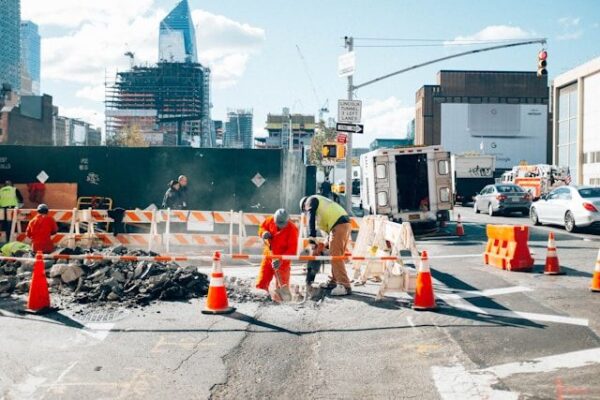
Walk onto an active job site, and your eyes naturally track the obvious dangers. You look up for overhead crane loads, keep your distance from heavy machinery’s turning radius, and check that everyone on the scaffolding has tied off.
You basically train your crews to spot these big risks from day one. But the truth is that construction hazards aren’t always the glaring, obvious dangers you’re familiar with. According to the Bureau of Labor Statistics, the private-sector construction industry recorded 1,034 workplace deaths in 2024, the highest of any private industry.
While common hazards like falls and direct impacts account for many of those deaths, less-publicized site events also contribute to serious injuries and fatalities. In this article, we’ll look at five of these less obvious hazards that can turn routine work into a fatal accident.
Striking Underground Utilities
Underground utilities can turn an ordinary excavation into an emergency in seconds. Buried gas lines, electrical cables, and water mains give no warning until a bucket or shovel makes contact. This isn’t a rare problem. The Common Ground Alliance’s DIRT Report recorded 196,977 reported damages to buried utilities in the U.S. and Canada in 2024 alone.
The consequences of such events can go far beyond a damaged cable. A utility strike can cause electrocution, fire, explosion, flooding, or a sudden change in ground conditions.
But calling 811 may not really be enough. In fact, the Associated General Contractors of America reports that nearly two-thirds of utility strikes occur even after the location service has been contacted. So, marking lines on the ground is just one step. If you can, physically verify what’s down there before the excavator bucket hits the dirt.
Unstable Structures During Excavation or Demolition
Digging changes the forces a nearby structure has quietly depended on for years. You start removing soil for a new foundation, and suddenly the sidewalk across the street cracks. Or you knock down an interior wall, and the ceiling starts to sag.
A tragic case in Brownville, Maine, in 2024, when a trench worker was killed by a collapsing retaining wall, shows just how dangerous this can be.
This case and many more like it are a stark reminder that accidents on construction sites aren’t just about the structure you’re building. They can also happen because of the structures next to you. This is why a thorough pre-work assessment of all nearby buildings and walls is non-negotiable.
Stored Energy in Hydraulic and Mechanical Systems
You’ve switched a machine off and think it must be safe to work on, right? Not always. Hydraulic systems, springs, counterweights, and even suspended loads can hold significant stored energy. And that stored energy is dangerous enough to seriously hurt someone, sometimes fatally.
If you think this happens only in Hollywood, think again. In December 2024, an OSHA investigation found that a construction worker was killed after a concrete mixer unexpectedly started while he was cleaning it. He was pulled into the machine’s auger paddles.
This is why lockout/tagout is critical. Construction law professionals at the Loewy Law Firm explain that lockout/tagout accidents can result from the “unexpected startup and cycling of a machine”. The firm notes that a lockout/tagout malfunction can cause blunt-force and crushing injuries, as well as burns.
That’s why you shouldn’t rush machine shutdown, lockout/tagout, and verification steps simply because you think a repair “should only take five minutes.” Those extra few minutes could be what keeps a routine repair from becoming a fatal construction accident.
Toxic or Oxygen-Deficient Atmospheres
Trips, falls, scaffolding accidents, and demolitions get all the headlines, but confined spaces are no less hazardous. Bad air in these places can actually incapacitate a worker within minutes.
A 2025 incident in Mobile, Alabama, shows just how dangerous this can get. On August 11, three workers entered a manhole to install and repair sewer lines. They were overcome by sewage gases. One worker managed to get himself out, but the other two sadly died. OSHA later found that the employer had no confined-space entry program, procedures, training, or emergency response plan.
There’s also a secondary danger here: co-workers who rush into the space to rescue their colleagues without proper equipment or rescue procedures.
The lesson here is clear. Don’t assume a space is safe because someone entered it safely yesterday. Confined space safety means that you have to identify any potential hazards and have a rescue plan before anyone goes in.
Combustible Dust, Unexpected Fire Risks, and Respiratory Issues
Wood dust, drywall dust, and metal particles look harmless in a pile. But suspend them near a spark, and you could have an explosion to contend with. Construction dust isn’t just an explosion hazard. It can damage workers’ health over time.
The UK’s Health and Safety Executive estimates that more than 500 workers in the construction industry die from exposure to silica dust yearly. And in California, health officials identified 41 possible cases of silicosis through electronic disease reporting in just nine months in 2025.
This is exactly why good housekeeping matters on construction sites. Proper dust collection and hot-work controls aren’t just paperwork. They keep ordinary dust from becoming a fire, an explosion, or a career-ending illness.
How Can Construction Companies Reduce These Less-Obvious Risks?
Most of these hazards share one root cause: they were hiding in plain sight.
Louis Panzer, Executive Director of North Carolina 811, said it well when discussing utility damage prevention. “The solutions are in front of us. What’s needed now is the will to implement them at scale.”
His point applies beyond utility strikes. Construction employers must build a culture of proactive hazard identification before a shovel even hits the dirt. Here’s a quick guide on how to do it:
| Step | What To Do | Why It Matters |
| Access Risks | Conduct task-specific risk assessments for every job | A one-size-fits-all plan doesn’t work. You need to identify the unique hazards of each task |
| Locate & Map | Physically locate underground utilities and assess existing structural risks | Don’t just rely on a map. Verify. As the data shows, most strikes happen even after 811 is called |
| Isolate Energy | De-energize, isolate, and lockout/tagout equipment | This prevents the unexpected release of stored energy that can kill or maim |
| Test Air | Test potentially hazardous atmospheres in confined spaces | You can’t smell or see toxic gases or oxygen deficiency. You have to test with the right equipment |
| Inspect Supports | Thoroughly inspect all temporary structures and supports | A temporary failure is just as fatal as a permanent one |
| Empower Workers | Train workers to recognize these less-obvious hazards | Workers are your eyes and ears on the ground. They need the knowledge to spot danger |
| Stop & Access | Have a clear “stop work” authority if site conditions change | A sudden change in the weather or the work plan can create new, unforeseen hazards |
FAQs
What is the most dangerous hazard on a construction site?
There isn’t a single answer. Falls are consistently a leading cause of death in the industry. However, the “most dangerous” hazard depends entirely on the work being done. The key is to assess and prepare for the specific hazards of your unique job site.
What are some less obvious hazards on construction sites?
Beyond the usual suspects, we’re talking about hidden dangers like underground utilities ready to be struck, stored hydraulic energy in machines that are “off,” toxic atmospheres in confined spaces, and unstable adjacent structures that can collapse.
How can construction site accidents be prevented?
It starts before the work begins. It’s about meticulous planning, thorough pre-work hazard identification, and proper training. It also means having a system for what to do to prevent accidents if conditions become unsafe.
Final Thoughts
Construction safety is more than just hard hats and high-vis vests. It’s also about handling the real threats that often hide in plain sight. We’ve discussed some of those hazards in this guide.
Make it a habit to identify these hazards, and you’ll be creating a workplace where everyone makes it home safely at the end of the day.




