






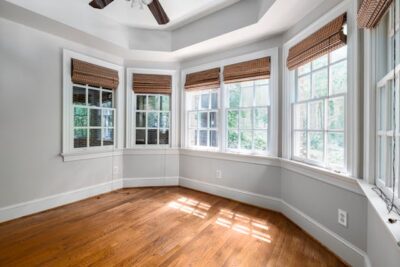
When the clocks turn back and dusk starts to arrive earlier and earlier, your home’s electricity usage increases significantly. Many homes require artificial light sources during the day, particularly if the residents work from home. Combined with energy bills and other ever-increasing living costs, excessive electricity use can really start pinching.
A home that does not get enough light also has a negative impact on the mental health of the people who live in it. VeryWell Mind explains that a lack of sunlight directly increases the risk of seasonal affective disorder (SAD), more commonly referred to as “winter blues.”
A straightforward intervention to maximize the amount of daylight in your home is to re-examine your windows. Could a redesign or upgrade help you make the most of the daylight your region receives?
Here are three modifications you should consider; they go beyond window-dressing, pun intended.
1. Bay and Bow Windows for Light and Panorama
You should definitely explore these designs if you are fortunate enough to live in the beautiful countryside or have a view worth absorbing near your home.
These glass-to-glass windows allow you access to panoramic views while capturing available sunlight from multiple angles. Since they project outwards, you can expect significantly more natural light to enter your home than is possible with a conventional window.
Notably, both these designs are very similar with one subtle difference. Bay windows have the brick wall below in the same shape. Thus, the bricks support the weight of your window. In contrast, bow windows have flat brickwork below them.
From a daylight perspective, bow windows are usually preferable due to the larger surface area and standout curved design. That said, bay windows are good at facilitating airflow, which can be a relief in sultry, stuffy days.
Another massive advantage of these designs is the stunning improvements they make to your indoor aesthetic. The window area becomes a focal point where you can make a reading nook, place a love seat, or invite guests for coffee.
What’s more, bay windows (or “Oriel” windows as they are sometimes called) can increase your interior living space without altering your home’s footprint.
Effectively, you can get more space to be yourself without paying more property taxes. If you install energy-efficient glazing, you can maximize the outcomes, lowering electricity bills. That adds up to impressive cost savings.
2. Hardworking Window Treatments and Coverings
A practical and cost-effective way to optimize daylight usage for your home is through intelligent window treatments. Think beyond conventional curtains or drapes to find coverings that can work hard so your electrical fittings don’t have to.
Silhouette shades are great at controlling the light that enters the house. You can adjust the brightness/dimness levels so the result is neither too harsh nor too dull. Over time, you will reduce your need for artificial light.
Another option is using motorized pirouettes that allow you to control the intensity of natural light in your room. The Blinds Source notes that this approach can work especially well for inaccessible windows. A motorized arrangement makes it simple to adjust the light, soften it during the harsh hours, and optimize it on dull, winter mornings and afternoons.
Blinds and other coverings can also be useful for temperature management in the winter. The US Department of Energy strongly recommends the use of energy-efficient window attachments. It notes that 30% of your home’s heating energy can dissipate through windows.
When you have coverings, you can regulate temperatures effectively, lowering your energy bills.
3. Smart Windows With Responsive Features
In the modern age of autonomy, why not make windows smarter and adaptable to different levels of sunlight?
A 2025 study in Energy and Buildings examined the possibility of a smart window with dual-grating. This design has transmissive and non-transmissive strips alternating with each other. The idea is to match the sun’s trajectory, providing different transmittances to maximize daylight indoors.
Research in this field is ongoing with an impressive gusto. A recent Advanced Science study proposed a three-state thermochromic smart window that can modulate across the solar spectrum. It uses new-age materials, such as tungsten-doped vanadium dioxide and perovskite, a window film gaining rapid popularity.
The American Association for the Advancement of Science (AAAS) explains how perovskite works–keeping smart windows clear in winter and turning them dark in summer. Apart from this temperature-driven transition, these windows may also be able to keep buildings cool and generate power.
It might be a while until we can see smart windows more easily available and installable. However, the technology surely holds promise as an eco-friendly solution to get better indoor light without relying on artificial sources.
As your portals to the outer world, windows deserve attention. You may have had traditional flat ones forever, but don’t let that stop you from exploring new, more eco-friendly designs. If they also end up adding to your home’s curb appeal and interior space, that is a bonus.
Natural light can brighten up your house in many ways, improving physical health and mental well-being and reducing electricity bills. It is an objective worth persevering for.






