








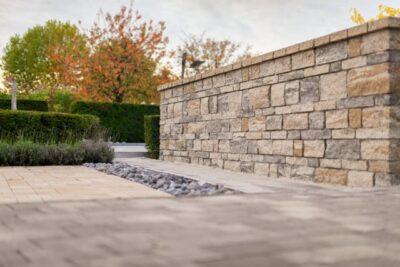
The human eye is designed to cherish symmetry and clear visual elements. Now, suppose you were to walk into a shopping complex that looks nothing short of a mess. The pathways are leading up to nowhere, and seating areas are spread across like confetti.
You’re left wondering where exactly to go. What if the same space were to have clearly defined pathways and a proper structure, so to speak? Naturally, the area would feel organized and almost as if it’s been choreographed. Well, that’s the power of hardscaping.
It’s no surprise that the worldwide hardscaping market reached a solid $22.3 billion in 2024, with a projected CAGR of 6.1% through 2033. Commercial developers are investing more in outdoor spaces that are both aesthetic and easily navigable.
Based on that, this article will explore three ways in which hardscape creates structure in commercial exteriors. They will also help you know how commercial spaces can turn into areas that feel user-friendly and downright enjoyable.
Spatial Boundaries Without Walls
One tricky job that commercial exteriors have is to organize people without telling them what to do. Now, walls and fences are great options on paper. In practice, they can come across as a bit too ‘cold.’
Good hardscape elements can gently guide pedestrians, and the latter is more likely to listen. A recent study confirmed that people respond strongly to tactile signals in outdoor commercial spaces. This is especially true of features that influence perceptions of comfort and safety.
So, keep those markers clear, and people will move more freely and linger longer. Here are some common hardscape techniques that do the heavy-lifting for you:
- Low-seat walls or raised edges that define a space while still welcoming people to sit
- Paved transitions that say, “keep moving” or “feel free to stop” without a single sign
- Fixed elements along the perimeter that frame the main areas without blocking views
For commercial establishments that can get away with something whimsical, cottage-inspired landscaping is a choice worth trying. Hardscape elements that may accompany include gravel pathways, stone seating areas, rustic bird baths, and vibrant pergolas.
A general example would be an open-air retail center where pedestrian flow is maintained on smooth concrete. On the other hand, customers at a cafe sit on a slightly raised textured platform. There’s no need for sign barriers or instructions.
The design will be such that people will instinctively know. Commercial environments, in particular, need smart hardscape given the high foot traffic and the need for behavioral guidance.
Elements of Visual Hierarchy
The truth is that open commercial spaces can be overwhelming on our senses. What’s worse is if such spaces are like a maze, where visitors end up wandering aimlessly or simply miss key areas altogether. Hardscape is meant to solve this problem by giving the eye something to follow.
Yes, this is about establishing a visual hierarchy. One of the most versatile tools for this is modular planters. You can think of them like visual punctuation marks.
As PolyMade shares, it’s possible to get creative with the contours based on shapes like round, angled, tapered, and more. This adds personality and depth to a space, whilst helping visitors ‘read’ its layout intuitively.
Now, establishing visual hierarchy can be tricky. So, here are some strategies to follow:
- Lead the eye to key features by aligning planters and walls naturally.
- Take the help of size, repetition, and placement to distinguish main areas from peripheral spaces.
- Be mindful of spacing by positioning planters and other architectural highlights evenly.
- Have one key focal point, which may be a central fountain or an entryway.
A corporate courtyard may introduce rows of custom concrete planters to subtly frame the central walkway while guiding the eye towards the lobby. All of a sudden, a large open space begins to feel cohesive and easy to navigate.
Key Activity Zones for Function and Flexibility
A third way hardscape creates much-needed structure in commercial exteriors is through the delineation of activity zones. The former two help guide movement, but this communicates clearly where people may gather and interact.
In high-traffic commercial spaces, even mild structuring makes a big difference in determining the flow and usability of the area. A recent study from 2024 found that more commercial landscapes are relying on natural elements like plants and water features to enhance user experience.
They also tend to simplify layouts for ease and comfort. Visitors generally respond positively to such spaces, as evidenced by how they engage with their surroundings. On that note, let’s look at some elevated strategies for defining activity zones:
- Changes in paving patterns that indicate transitions between walking paths and gathering areas
- Integrated greenery here and there, along with water features that allow visitors to pause and enjoy
- Strategic seating arrangements within open zones that invite people to spend more time
For instance, a mixed-use plaza area might have some scattered greenery and textured paving to separate a casual seating area from the main pedestrian path. At the same time, a small fountain can feature a zone to pause and relax. The goal is to include elements in such a way that passersby feel encouraged to interact with the space more authentically.
Beyond the looks, hardscaping elements can become your secret weapon for low maintenance. With the features we discussed, commercial spaces won’t require constant mowing, trimming, or rearranging.
Smart materials mean fewer (unpleasant) surprises and more freedom to focus on what really matters. So, you’re not just striving for design flair. When you get hardscaping right, it’s possible to make commercial exteriors work smarter, not harder.




