










On a new 500,000-square-foot hospital expansion under construction adjacent to an active campus, crews work on a tight schedule. Any delays feed directly into an opening date tied to patient care commitments and potential late penalties.
On the third floor, at least three languages are spoken across the crews, and a mechanical team has ruptured a water line, sending water draining into the second floor below, where drywall installation is already underway.
The foreman, the nearest person with a radio, is on the other side of the project. By the time someone physically tracks him down, and the water is shut off, 15 minutes have passed and two sections of newly installed drywall are saturated, pulling that portion of the second floor off schedule.
Radios on the project went to supervisors and key personnel, the same allocation decision general contractors have carried from project to project for the better part of three decades. Most large construction projects run on that same communication architecture today.
The executives managing those projects inherited that decision, and most have never had a practical reason to question it, because the model has persisted the way most jobsite practices do, carried forward by cost, inertia, and the assumption that no visible catastrophe means the current architecture is working.
The Cost of a Communications Gap
The absence of a visible catastrophe is not the same as an absence of cost. Workers who cannot self-coordinate are forced to wait, and a crew that cannot reach a supervisor to confirm next steps stops work until someone tracks down an answer. On a single-site project, that can get absorbed into the schedule.
Across a portfolio of concurrent projects, it surfaces as a pattern in labor costs, phase completion timelines, and the margins that ownership groups and lenders track most closely.
When site conditions change, workers without direct communication access depend on supervisors to relay hazard information, and that relay introduces exactly the delay and error the situation cannot afford.
Workers without radios miss critical updates until someone finds them in person, and on a project where the owner’s risk tolerance is compressed by a hard opening date, that gap compounds across every shift.
When an incident occurs and the investigation reviews whether workers had timely access to hazard information, the answer on many commercial construction sites is that they did not.
Incident response breaks down most visibly when hazard information travels person to person across a site with 300 to 400 workers. Delay and error enter the chain at exactly the moment neither is acceptable and the 15-minute delay in that hospital construction scenario is closer to the norm than the exception on projects running under a traditional radio allocation model.
 The Case for Site-Wide Communications Distribution
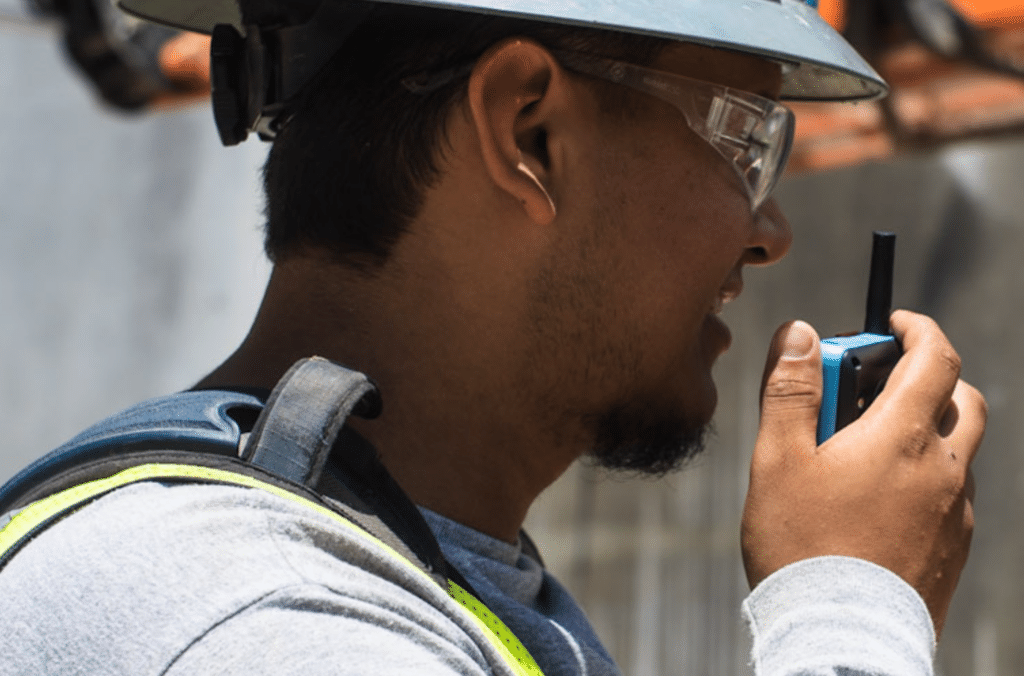
Purpose-built smart radios, a recent invention, are designed for large, complex jobsite work. They have emerged as a distinct equipment category, differing from consumer devices adapted for construction.
These devices are weatherproof, drop-rated, and built without internet access and consumer apps that prompt smartphone bans on construction sites, making them policy-compatible for general contractors who have already restricted personal devices for security or productivity reasons.
The cost model has also evolved, changing the financial calculation for universal distribution. Subscription-based per-device pricing converts a prohibitive capital purchase into a predictable operating expense that scales with project headcount, enabling every worker to be equipped without a large upfront procurement decision.
For executives managing multilingual crews, artificial intelligent (AI)-enabled translation capabilities built into some smart radios change project operations and culture from day one.
A Spanish-speaking laborer and an English-speaking foreman exchange information in real time, each in their own language, even in high-noise environments, without requiring a bilingual supervisor to translate, removing a friction point that has traditionally slowed coordination on many sites.
What Changes When Every Worker Has a Radio
Site-wide distribution changes the operational reality of a job site in ways that show up immediately in response times, trade coordination, and the idle time that quietly inflates labor costs across every phase. Hazard alerts reach all workers simultaneously rather than moving through a supervisor relay chain that introduces delay and error at each handoff.
Trades coordinate sequencing without waiting on a supervisor to pass the message, compressing phase completion timelines, and multilingual crews share the same situational awareness across the entire site, reducing the miscommunication-driven rework that rarely appears as a line item but consistently affects margins.
On large-scale commercial construction projects where every worker is provided a smart radio, the first thing to change is response time, because a supervisor who can be reached directly by any worker responds faster than one who waits for information to travel up a relay chain.
Phase handoffs between trades speed up significantly when crews can coordinate without waiting on a supervisor, and the time that accumulates across shifts begins to show up in project data in ways it never did before, creating a baseline that owners and project executives can manage against.
The Conversations Owners Didn’t Know They Were Missing
Universal distribution generates operational data that most commercial construction executives have never had access to, because the infrastructure to capture it did not exist when radios covered only supervisors. Crew coordination patterns, which teams went dark and when, and where communication broke down across a project, are now visible in ways they were not under the standard allocation model.
General contractors who have moved to universal distribution consistently describe a version of their projects they did not have access to before.
The Financial Case
Revisiting the earlier hospital construction project, the water was eventually shut off, the drywall was replaced and the project moved on. What didn’t change was the radio policy that made the delay inevitable.
Ownership groups respond to the total project cost impact across schedule performance, labor efficiency, and incident rates, and safety metrics presented in isolation rarely move the conversation the way a consolidated operational picture does. Fewer incidents reduce workers’ compensation costs and cut project delays tied to investigation and regulatory response.
Reduced wait time and rework translate directly into labor efficiency gains visible in phase completion timelines and total project cost. For executives presenting in competitive bid environments, demonstrated safety and coordination infrastructure differentiates a general contractor in the proposal process.
General contractors managing complex, multi-trade, multilingual projects who have moved to a site-wide communication infrastructure track results in their margins, schedule performance and operational data from their projects. The 15 minutes it took to find that foreman on the hospital expansion are not recoverable, but the next 15 minutes are.
Radio silence is a management choice, and the executives who are changing it are now learning what they were missing all these years.
Kevin Turpin is CEO of Weavix, an IoW frontline radio communication that provides facility owners, manufacturers and general contractors a single platform to manage all field communication and workforce management of all contractors and employees.




