










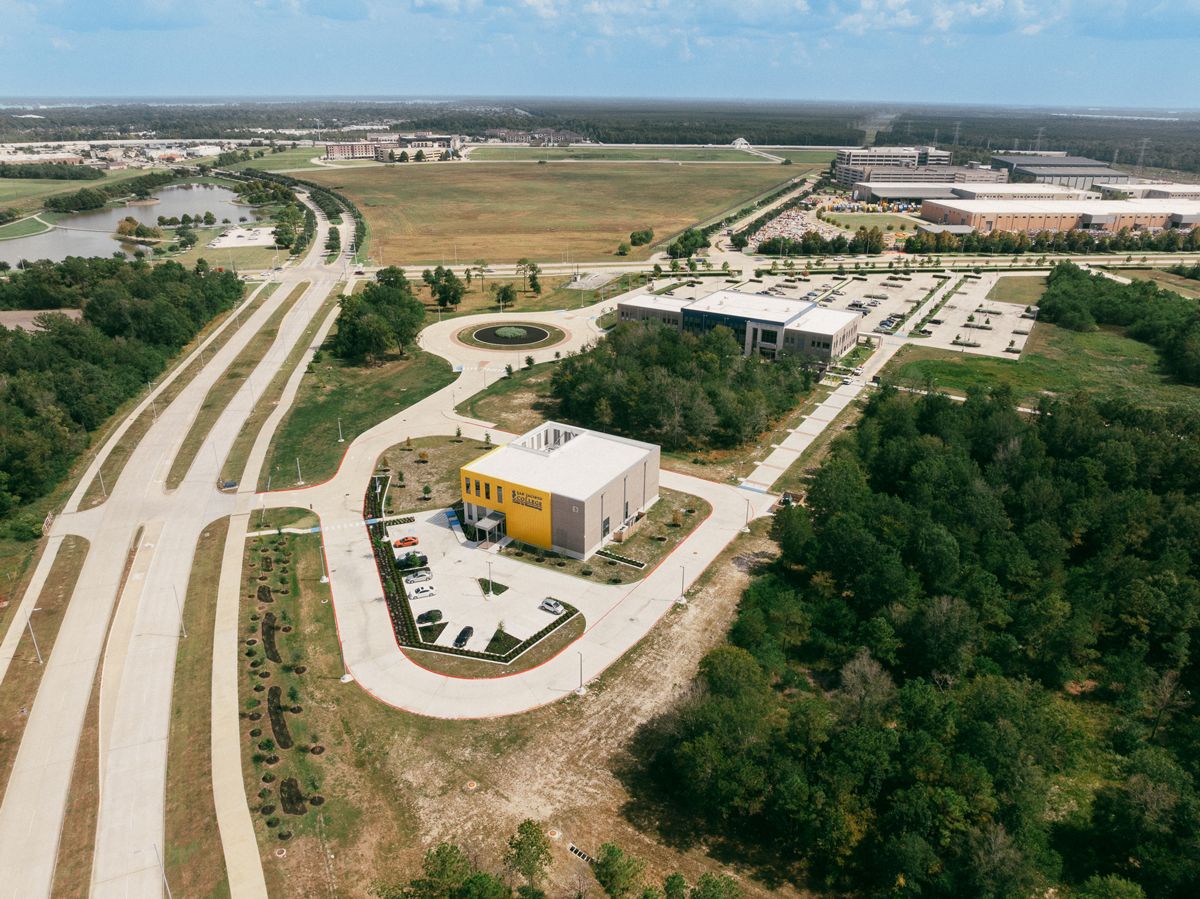
When San Jacinto College (SJC) opened the doors to its groundbreaking Center for Biotechnology at the college’s North Houston Generation Park campus, the college became an anchor for a robust industry ecosystem, creating career pathways for skilled professionals in this rapidly growing industry.
Designed by Pfluger Architects, the 10,000-square-foot facility offers students experiential learning opportunities with access to cutting-edge resources and immersive training environments essential for these highly specialized, in-demand careers.
The Generation Park area will soon be home to an Eli Lilly biomanufacturing facility as well as other complementary businesses, further establishing an innovation district with a competitive advantage: proximity to cutting-edge research and training, specialized talent pipelines and commercial real estate opportunities.
The aggressive design and construction timeline for the new Generation Park campus building required a coordinated effort between partners. This included Page, who designed the building envelope and site, which features an elegant pedestrian experience that physically connects to nearby trails and campus amenities, along with general contractor Tellepsen Builders and Pfluger Architects, who designed the building interiors, including MEP.
Biomanufacturing is one of the Fastest-Growing Technical Career Fields
Employment for biological technicians is projected to grow faster than average for all occupations, according to the U.S. Bureau of Labor Statistics, driven by increasing demand for new therapies, vaccines and materials.
Biotechnology is the application of biology toward the advancement of technology and biomanufacturing is a subset where trained professionals are manufacturing products of the future, often with living cells and biological chemicals. The industry’s expansion promises regional jobs, global innovation and a new generation of skilled technicians.
Meeting that demand requires more than curriculum development. It requires coordination among educators, industry and designers who can create spaces reflecting modern production realities.
Early Lessons in Workforce Design
Workforce development, economic policy, and architectural design have become deeply intertwined in Houston’s biotechnology story. Several years ago, when pharmaceutical giant Amgen evaluated Houston as a potential site for a major manufacturing facility, Generation Park was selected as the national runner-up, but ultimately the site went to North Carolina instead.
Christopher Wild, San Jacinto College’s Associate Vice Chancellor of Biotechnology says that the company wanted to see a workforce program in place. “They also wanted to see a level of expertise that would give them the confidence the training required for their operation would be successful.”
That experience provided valuable lessons about workforce pipeline and the type of training facility needed to attract future investment. San Jacinto College partnered with the National Institute for Bioprocessing Research and Training (NIBRT) in Dublin, Ireland—an organization with two decades of experience training biomanufacturing technicians for global pharmaceutical companies. The partnership formalized in 2023, gave the college access to curriculum, expertise and international credibility.
But curriculum alone wasn’t enough. The college needed physical infrastructure that could deliver on NIBRT’s standards and meet industry expectations.
 Biotech Center 1.0: Building the Foundation
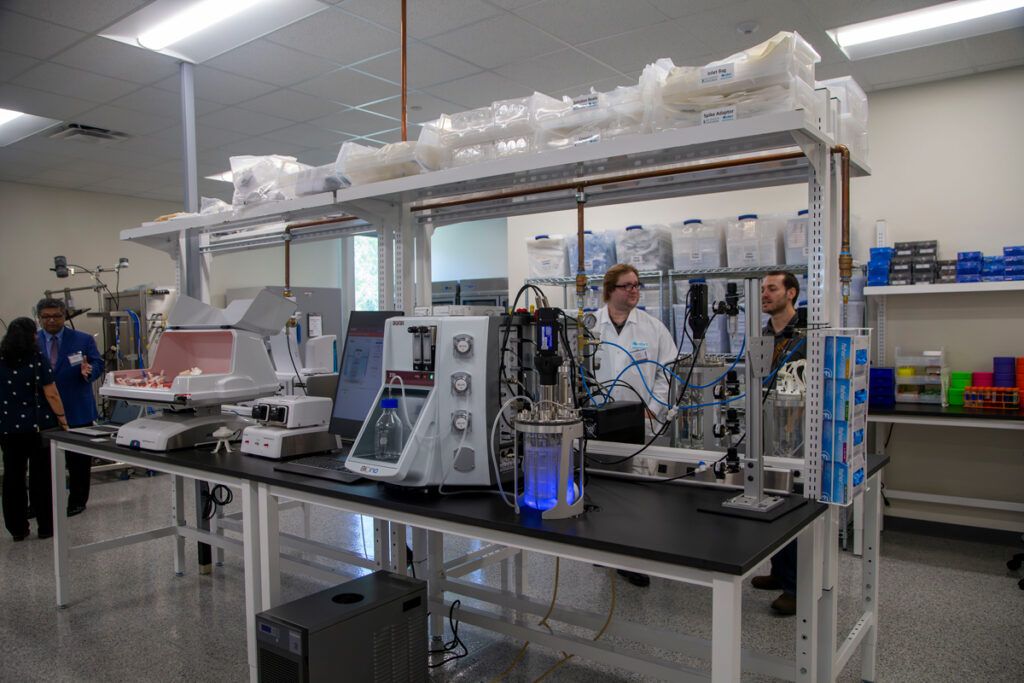
Before we could design a purpose-built facility, we had to prove the concept could work. Working with SJC’s team, Pfluger overhauled existing lab spaces at the college’s South Campus—transforming traditional science labs into NIBRT-certified biomanufacturing training environments.
The retrofit project, referred to as Biotech Center 1.0, required developers to reimagine everything from benchtops to HVAC systems. The center has the capacity to deliver the training needed within the existing area—it’s just a smaller footprint and wasn’t purpose-built. More importantly, it taught us what would be needed when the opportunity came to design a dedicated facility at Generation Park.
Manufacturing is in Houston’s DNA
The Houston region has long combined science, industry and innovation—from petrochemical processing to aerospace engineering to the world’s largest medical center. The SJC program focuses specifically on the manufacturing aspect. “This is a manufacturing technical degree that uses the biological sciences as the method to do the manufacturing,” Wild says. It sounds esoteric—biotechnology, biomanufacturing—but it’s fundamentally about making things.
Houston already hosts companies such as Lonza, Fujifilm, CTMC, Cellipont, and BioNova. Coupled with the Texas Medical Center’s leadership in advanced cell and gene therapies, Houston’s conditions for growth were already strong. What the region lacked was a coordinated workforce pipeline—an education and training system built specifically for biomanufacturing. Employers could find talent, but not technicians already trained in regulated production environments. San Jacinto College set out to close that gap.
As the exclusive provider of the NIBRT-certified biomanufacturing training environment for the southern part of the United States and the only in Texas, San Jacinto College is leading the way with the region’s first and only associate’s degree in biomanufacturing technology, a two-year technical degree program preparing students to enter this in-demand career field. The Center also offers certificates and shorter credentials for post-graduates to meet workforce needs.
Reality as Curriculum
Walking through the new Center for Biotechnology, what strikes you immediately is how little it resembles a traditional educational facility. There are no lecture halls. No classrooms with rows of desks. No auditorium seating or projection screens.
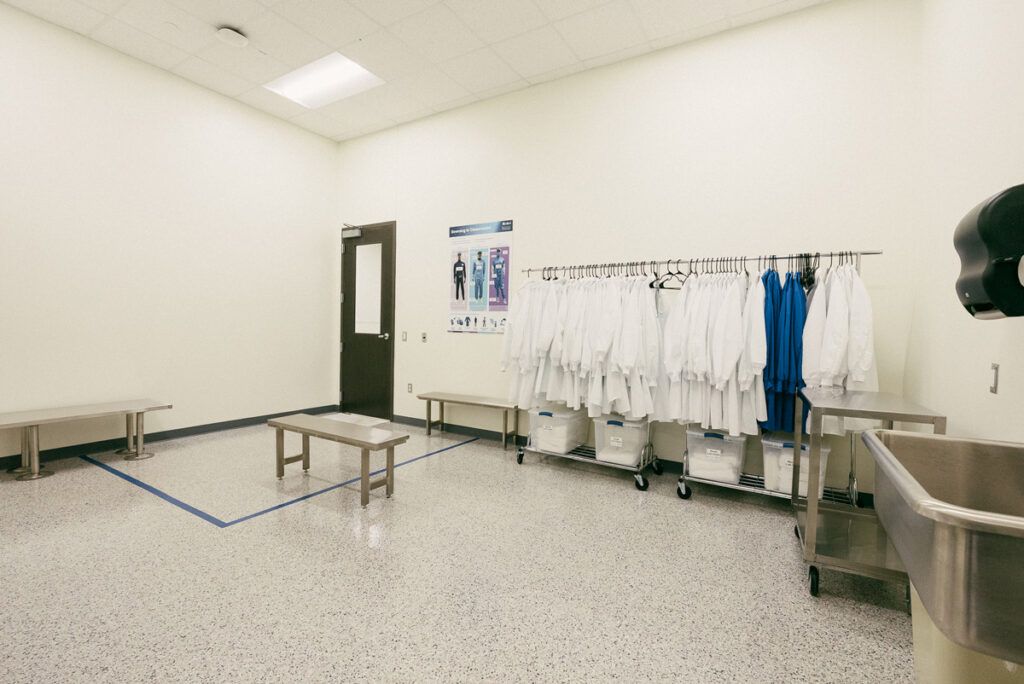
Instead, you find what looks unmistakably like a working biomanufacturing facility—because that’s exactly what it was designed to be. The plan follows the flow of a real manufacturing workplace—gowning areas, cleanrooms and production suites organized to teach the discipline and communication required in regulated environments.
Pfluger Architects designed a highly adaptable and flexible lab module using a partition layout to support the college’s current needs for curriculum, support spaces and circulation, with spaces that can easily transform along with the college and curriculum. The center is designed as a laboratory suite with an entry lobby fitted with lockers, breakroom, and workroom for students and staff.
The laboratory suite is accessed through a control gowning room where students will practice real-world entry into a “clean environment.” The specialized training labs for Upstream and Cell Processing, Downstream, Fill and Finish and Clean Room Qualifications immerse students in real-world experiences to become prepared and certified for future opportunities in the biotech industry.
In early advisory committee meetings, industry partners emphasized the need for alignment between training and actual work conditions. Many companies were hiring graduates with science degrees but little exposure to production practices, leading to long onboarding times and frequent turnover. The industry partners wanted something different: a technical program at a community college that would train students specifically for biomanufacturing roles.
“Students would understand the hands-on nature of the work. “They wanted that type of training to match perfectly with the positions,” Wild explained. This alignment would reduce onboarding costs and, more importantly, reduce turnover while offering students an affordable community college education.
Most San Jacinto students are the first in their families to attend college. Many are balancing work and education. They don’t have time for abstraction; they need training that leads directly to employment.
The Center’s design eliminates the gap between learning and practice. Lecture space exists in an adjacent building, easily accessible but deliberately separated. The Center for Biotechnology itself remains focused as a manufacturing environment within an educational facility.
The Test of Real-World Readiness
In summer 2025, students who had completed just one year of the program participated in internships at various Houston-area companies. In this highly regulated industry, interns typically shadow professionals and receive additional training, but they rarely perform actual manufacturing work.
After one year in a community college program, students were trusted to manufacture therapeutic products in live production environments. That’s transformative.
“We’re happy to say that these students were so well trained they were able to qualify for full-time manufacturing roles and do manufacturing on the manufacturing floor on their internships,” Wild says. “This establishes a brand-new precedent, certainly for Houston, but I think more broadly the country.”
 The Eli Lilly Effect
The timing couldn’t have been more remarkable. In the same week San Jacinto College held its grand opening for the Center for Biotechnology, Eli Lilly announced plans to invest $6.5 billion in a biomanufacturing facility at Generation Park, the largest pharmaceutical investment in Texas history.
The Eli Lilly facility will require hundreds of trained technicians. Unlike the Amgen situation years earlier, Houston is ready. SJC has the institutional capacity to meet that demand—not just through its biomanufacturing program, but through creative partnerships.
The expectation now is that the region will become a therapeutic manufacturing hub for the U.S. When education, government and industry share a goal, design becomes the medium that connects them.
A New Model for Technical Education
As architects, we’re accustomed to thinking about buildings as individual projects. But facilities like the Center for Biotechnology are more than educational spaces, they’re economic infrastructure. They enable programs that change career trajectories, make policy investments tangible and translate national workforce needs into local opportunity.
Architecture plays an essential role in that progress. It links educators, employers and community leaders so training aligns with the needs of real workplaces. The same approach that shaped the Center can guide other growing fields—clean energy, data science and advanced manufacturing—anywhere hands-on learning drives local growth and spurs innovative ecosystems.
Projects like the San Jacinto College Center for Biotechnology show that when design is rooted in process, partnership, and purpose, it helps entire communities move forward into the future.
Chris Laack, AIA, NCARB is higher education practice leader at Pfluger Architects, based in the firm’s Houston, Texas, office. Pfluger Architects is a Texas-based architecture firm with extensive experience in educational facility planning, design and construction administration. Named one of Building Design + Construction’s Top 50 Architecture Firms in the 2024 Top 200 List, including the Top 10 K-12 Architecture Firms List, it partners with communities and institutions to create engaging learning environments. Learn more at https://pflugerarchitects.com/.




