








Which OEM leads off-highway electrification? This is one of the questions we are most often asked as analysts. What does “leading” mean anyway? Most machines sold? Widest portfolio? Most aggressive target? Or most innovative technologies? For the first time we’ve built a framework to assess, in an unbiased way, the companies that are the leading OEMs in off-highway electrification.
Electrification is progressing unevenly across countries and applications and OEMs are approaching this mega-trend in very different ways. While many now offer at least one battery electric machine, relatively few have developed the portfolio, technology, infrastructure, and commercial scale required to differentiate themselves from the competition. Our ranking of the top 10 off-highway OEMs looks at which companies are doing more than simply launching a single model to check a box. The strongest performers are building broader electrification strategies that go beyond pure machine sales. For OEMs further down the ranking, or missing from the list entirely, the results provide a practical roadmap for catching up before the market enters its next phase of development.
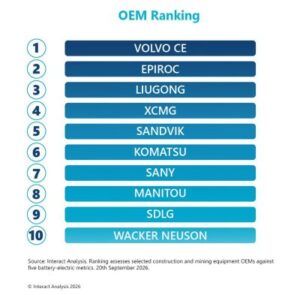
Volvo CE ranks first in our off-highway electrification benchmark
The highest-ranked OEMs, including Volvo CE, Epiroc, Liugong, XCMG, and Sandvik, combine several different strengths across our benchmark – no single metric determines leadership. Each of these OEMs meets two or more of the following criteria: a commercially available electric portfolio, meaningful battery-electric vehicle sales, clear electrification targets, in-house powertrain capabilities, and charging or infrastructure support.
How the benchmark works
Our ranking system focuses on battery-electric machinery, rather than assessing alternative fuels more broadly. Hydrogen and hybrid machines have been excluded to provide a consistent comparison of OEMs’ fully electric offerings and capabilities. The analysis covers construction and mining applications, which also benefits OEMs with exposure to both markets, such as Komatsu.
Each OEM was assessed against five core metrics:
- Electric portfolio breadth; measured by the number of commercially available electric models relative to the OEM’s overall off-highway portfolio.
- Battery-electric unit sales in 2025.
- The presence and strength of a measurable electrification target (i.e. has the OEM committed to a target).
- In-house powertrain capabilities, including making their own battery packs, motors, inverters, and overall system integration.
- Infrastructure provision, including fixed chargers, mobile charging energy solutions, and supporting services.
There is more than one type of electrification leader
If leadership were determined purely by unit sales, Chinese OEMs would dominate the ranking. It is, therefore, understandable that Liugong, XCMG, SANY, and SDLG can be viewed as ‘scale leaders’. Their positions are supported by large electric portfolios, strong domestic adoption in China, and high production volumes. For these companies, electrification is arguably less a future target and more a structural feature of the Chinese market in which they have predominantly operated.
Volvo CE ranks as the overall leader because it combines strategic commitment, product breadth, and ecosystem capabilities. Its approach extends beyond electric machines in construction and roadbuilding applications to include charging solutions, and has set a clear target of 35% of machines sold to be fully electric by 2030. This combination of machines, infrastructure, and measurable commitment gives Volvo greater ability to influence how customers adopt electrification.
How can OEMs move up the ranking?
The precise order of the ranking can be debated, but the route to moving up the leaderboard is clear.
First, OEMs need to broaden their electric offerings across multiple product categories. Second, they need to build an electrification ecosystem around those machines, including both fixed and mobile charging solutions. Uncertainty around charging infrastructure remains a key barrier to wider adoption, meaning OEMs that can remove this uncertainty have an opportunity to differentiate.
Dealer support is another important but often overlooked requirement. Training dealer networks to sell, service, and support electric machinery will become increasingly important as customers move from pilot projects to larger-scale deployment. Finally, OEMs need to develop greater in-house powertrain and system-integration capabilities, and establish measurable electrification targets.
The next phase of competition in the off-highway electrification market will be won by those OEMs that make their electric equipment commercially viable, operationally practical and straightforward for customers to deploy. The danger for many OEMs is that the opportunity to progress up our benchmark has already passed.