





In the face of rising energy costs and stringent environmental regulations, industries are increasingly exploring innovative solutions to maintain operational efficiency while reducing their carbon footprint. In the thermal management space, especially for industrial applications, one of the most practical solutions is hybrid cooling—an approach that, while not entirely new to the industry, is being refined and adapted to achieve more significant energy savings, reduce operational costs, and minimize environmental impact.
Understanding Hybrid Cooling
Hybrid cooling combines two distinct methods—free cooling and active cooling—into a unified system designed to optimize energy efficiency. Free cooling, or passive cooling, harnesses cooler ambient air to dissipate heat from inside industrial enclosures without relying on large energy consuming entities, like a compressor. Active cooling, on the other hand, employs a conventional refrigerant cycle utilizing a compressor to manage internal enclosure temperatures actively.
At the heart of hybrid cooling is the intelligent integration of these two approaches. Typically, the system prioritizes free cooling whenever ambient conditions permit, thus reducing the need for energy-intensive compressor operation. When temperatures rise or cooling demand escalates beyond the capacity of passive cooling alone, the active cooling component engages seamlessly, maintaining optimal operating conditions within the enclosure.
In hybrid cooling systems, passive cooling is implemented using an exchanger filled with refrigerant. This refrigerant remains in a liquid state at the exchanger’s base, absorbing heat from the hot enclosure air and boiling upwards. Cooler external ambient air then condenses the refrigerant, cycling it back down. This process passively dissipates heat, leveraging environmental conditions to minimize energy consumption. The active cooling segment uses a compressor, which utilizes the same refrigeration cycle mentioned here.
Advantages of Hybrid Cooling Systems
The benefits of hybrid cooling in industrial settings extend well beyond basic energy savings. By combining passive and active cooling, systems like Pfannenberg‘s DHS Hybrid Series provide built-in redundancy. This ensures operational continuity even if one system component experiences downtime. For instance, if the compressor in the active cooling segment were to fail, the passive cooling system could continue providing partial cooling. This feature of hybrid cooling systems reduces system downtime and safeguards critical operations.
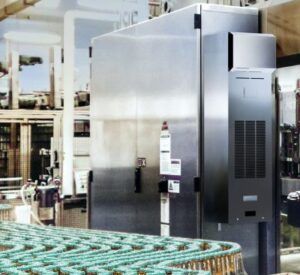
Image Courtesy of: Pfannenberg
Hybrid cooling solutions are especially beneficial in environments characterized by fluctuating cooling demands or variable ambient temperatures. Facilities operating in cooler climates or those maintaining climate-controlled environments are particularly suited to hybrid systems. A beverage manufacturing plant, for example, may have shifts running at partial capacity overnight, generating less heat and thus benefiting substantially from passive cooling alone during these periods. This adaptability allows hybrid cooling systems to optimize energy consumption effectively, translating into significant operational savings and sustainability benefits over time.
Addressing Modern Industrial Challenges
Hybrid cooling addresses several contemporary industrial challenges such as energy efficiency, carbon emissions and sustainability, and equipment reliability. The ideal hybrid cooling solution significantly reduces energy consumption compared to conventional cooling solutions while adapting to shifting environmental needs. This intelligent operation ensures the active cooling system’s compressor runs less frequently, not only lowering energy bills but extending the system’s component lifespan, resulting in fewer maintenance needs and a higher system life expectancy.
When it comes to sustainability and emissions, some hybrid cooling systems, like Pfannenberg’s DHS Hybrid Series, utilizes R-513A or other lower GWP refrigerants, compliant with upcoming environmental regulations due to its lower Global Warming Potential (GWP). This makes hybrid cooling not only an energy efficient but also an environmentally conscious choice, as systems align with increasingly stringent climate policies and sustainability goals.
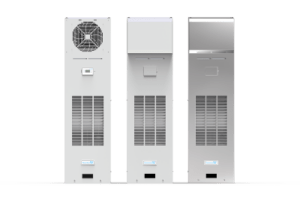
Image Courtesy of: Pfannenber
Future of Hybrid Cooling Technologies
As global industries increasingly prioritize sustainability and energy efficiency, hybrid cooling technologies are poised for substantial growth. Companies like Pfannenberg, committed to “Protecting People, Machines, and the Environment,” are at the forefront of developing solutions that balance performance with environmental responsibility. Looking forward, hybrid cooling systems are likely to evolve with even greater emphasis on reducing energy usage, integrating smarter controls, and adhering to stricter environmental standards. Modern hybrid cooling solutions are moving away from complex and costly components, favoring straightforward designs that rely on standard compressors activated only when passive cooling is insufficient. This simplicity enhances system reliability, reduces maintenance costs, and ensures minimal downtime-key factors for industries seeking operational continuity.
Variable-speed fans are increasingly being used to optimize performance, further improving system efficiency and adaptability to varying cooling demands. The ease of maintenance and repair, enabled by easily replaceable components, is a critical consideration that supports ongoing industrial productivity. Pfannenberg’s DHS Hybrid Series serves as a forward-looking example of how industrial thermal management can evolve, offering a distinctive interpretation of hybrid cooling that balances proven engineering principles with a commitment to sustainability. As environmental regulations continue to tighten, innovative cooling solutions like hybrid systems will become not just merely advantageous but essential for responsible and efficient industrial operation.
Hybrid cooling systems offer industries a practical, efficient, and environmentally friendly solution to thermal management challenges. By intelligently combining free cooling and active cooling, these systems not only reduce energy consumption and carbon emissions but also enhance operational reliability while reducing overall lifecycle costs, setting a new standard for future developments in .
Lucas Faulkner

Matt Roberts
Images Courtesy of: Pfannenberg




