





When one of North America’s fastest-growing outdoor furniture manufacturers committed to upgrading its aluminum production environment, it partnered with Nederman to build a system worthy of the people who show up every day to make the products.
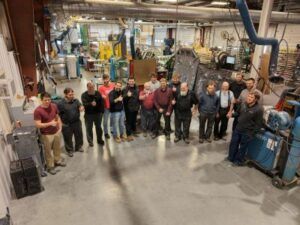
Image Courtesy of: Nederman
Berlin Gardens was founded in 1988 in the heart of Ohio’s Amish country on a simple idea: taking life outdoors. Under owner Sam Yoder, who acquired the company in 2009, it has grown from fewer than 20 employees to more than 230—becoming one of North America’s premier manufacturers of poly and aluminum outdoor furniture.
That growth brought responsibility as well as opportunity. When it came to the working environment inside the shop, Berlin Gardens chose to invest—and the results have been felt across safety, efficiency, and the daily experience of everyone on the floor.
A Culture That Walks the Talk
Berlin Gardens’ culture is built around a single word: HEART—Honesty, Efficiency, Attitude, Respect, and Trust. It shapes everything from how the company treats its largely Amish workforce to how leadership makes strategic investments. For Aluminum Production Manager Derrick Yoder, it was also the driving force behind the Nederman partnership.
Yoder joined in 2010 and helped grow the aluminum manufacturing and powder coating department from two people to 18. “Our core value as a company is HEART,” he says. “All of those things aligned with what we were trying to do with bringing Nederman in—creating an environment that our employees could actually come to work in and enjoy.”
As aluminum became central to Berlin Gardens’ lineup—with on-site fabrication, a growing standalone furniture range, and a recent merger with Pennsylvania-based Windward—leadership recognized that every system in the facility needed to keep pace. Air management was no exception.
The Case for Investment
Welding environments inherently generate fumes and particulate—a universal reality of the trade. For Berlin Gardens, rapid expansion in aluminum production made it the right moment to move from standard industry practice to something better. Owner Sam Yoder backed the initiative without hesitation. “We wanted to make sure that the employees actually enjoyed coming to work,” says Derrick Yoder. “That was the whole push behind everything. ”For Yoder, the case was also personal. A dedicated runner and former welder with 12-plus years under the hood, he knew from experience what air quality means day to day. “I could tell the difference on the day where I spent all day underneath a welder and then tried to get a run in,” he says. “It does make a difference.”
The business case was equally clear. Skilled welders are aging out of the trade faster than younger workers are entering it. “It’s harder to recruit younger welders who want to be here,” Yoder acknowledges. “Having a cleaner, safer, more comfortable environment is part of how you make the case that this is a good place to build a career.” A system that’s simple to operate, not just safer to work around, matters for that same reason. Daily cleanup was its own drag on production. Loose aluminum chips and dust had to be swept and hauled by hand at the end of every shift, time that could otherwise go toward output.
There were compliance and safety considerations too. Fine aluminum particulate is a recognized combustible dust hazard, not just a conductive one, and its housekeeping carries real regulatory weight. Properly engineered dust capture was a necessity in the machining environment, not simply good practice.
The Solution: An Integrated System
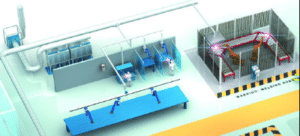
Working with Nederman, Berlin Gardens built an integrated air management system engineered around the facility’s specific sources of airborne contamination. The solution spans three core applications: weld fume extraction, chip and dust collection, and central vacuum for facility-wide industrial housekeeping. Together, they run as a single, demand-responsive system rather than standalone equipment, one designed to ask as little of the operator as possible.
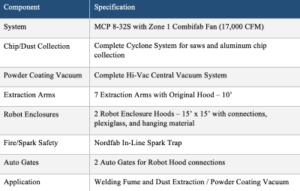
Image Courtesy of: Nederman
Weld Fume Extraction
At the center of the weld fume system is an MCP SmartFilter (8-23S) with Zone 1 Combifab Fan, handling 17,000 CFM across the facility. That central capacity feeds two weld fume applications on the floor: robotic welding and manual welding, each engineered with its own application-specific approach to capture. The system is demand-responsive by design, drawing only the energy required at any given moment. “Its not running at full capacity,” Yoder explains, “which means less maintenance over time, and you have potential to grow into the system.” Berlin Gardens currently operates at about 65% of capacity.
Robotic welding. The robotic stations, running at high continuous throughput, were the natural priority. Robotic welding also calls for a different capture strategy than manual welding, since the robot moves through changing positions and welding angles. A fixed capture point can’t keep pace with that movement the way it can at a stationary manual station. Nederman addressed this with a modular hood solution: fully enclosed 15’ x 15’ hoods fitted over each robot cell, connected via auto gates.
The approach gives more controlled, efficient capture than traditional source capture alone, suited to the robot’s range of motion. It’s one of the more distinctive elements of the Berlin Gardens system, and Yoder identifies it as the single biggest improvement: “Just containing that local smoke was a huge improvement. ”Manual welding. Seven 10-foot extraction arms at the manual welding stations give individual welders direct, at-source control over their own fume capture. Each arm is turned on and off as needed, putting agency over the working environment in each person’s hands.
Images Courtesy of: Nederman
Chip Collection
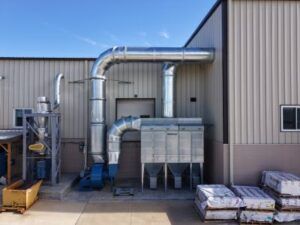
A complete cyclone system captures fine aluminum chips and dust from chop saws and cutting equipment at the source. It feeds into the same central extraction backbone as the weld fume system. Aluminum particulates of this size are widely recognized as a combustible dust hazard, not simply a conductive one. The system includes Nordfab Quick-Fit Ducting, an In-Line Spark Trap, and abort gates engineered for spark and explosion mitigation, bringing the machining area in line with best practice for combustible dust applications. “Having a proper chip collector with spark mitigation made a real difference for us,” Yoder says.
Central Vacuum: Facility-Wide Industrial Housekeeping
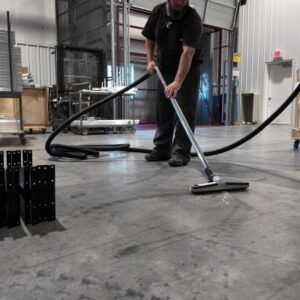
Beyond source capture at the machines, Berlin Gardens extended the system into what Nederman calls industrial housekeeping: a central vacuum infrastructure that keeps the whole plant clean, not just individual workstations. General housekeeping. The system was engineered around Berlin Gardens’ facility layout, providing access from 18 connection points throughout the plant. Each point is equipped with a TAV valve fitted with a switch.
The valve enables automatic start/stop operation, so suction runs only where and when it’s needed. This extends the same demand-responsive, energy-conscious design used in the weld fume system to everyday cleaning.Powder coating. A Hi-Vac central vacuum system replaced manual cleanup methods in the powder coating room. Sweeping and blowing, the previous approach, isn’t recommended for fine powder, since it recirculates rather than removes it. Powder is now captured directly at a central collection point, keeping airborne exposure minimal throughout the process.
Cleanliness carries extra weight in this application. Stray contamination in a powder coating environment doesn’t just affect worker exposure. It can affect finish quality and process consistency, so consistent, thorough collection supports product quality as much as it does safety.
No Disruption to Production
Berlin Gardens handled the installation in-house, working from Nederman’s design and ductwork specifications over one to two months—without stopping production once. “We were running the entire time,” Yoder confirms. “The system was designed really well. I wasn’t aware of any major issues.” From day one, running it has asked little of the team, a theme Yoder returns to when describing daily operation.
The Results
Two and a half years on, the impact is measurable across every dimension that motivated the investment. Air quality. “Just adding the two robot hoods, central vac, and the chip collectors vastly improved our air quality,” Yoder says. “We were able to close all the doors during the winter and not have a haze through the shop—which is huge.”
Efficiency. End-of-shift cleanup dropped from 15–20 minutes to roughly five—a 75% reduction that, across 18 team members, returns meaningful production time every day. “Anybody that’s in production will tell you that improving workflow and production time is one of the key things,” Yoder notes.
Safety. The cyclone system with spark mitigation brings the machining area in line with best practice for combustible dust hazards. In the powder coating room, workers who previously needed respiratory protection during cleanup no longer face the same exposure.
Ease of operation. “In the morning it’s literally pushing two buttons,” Yoder says. The HMI gives clear, intuitive visibility into system status. “Just by spending a minute or two with it, I could get a good feel of what’s going on. It’s pretty self-explanatory.” Maintenance over two and a half years has been minimal.
Built on HEART: A Company That Invests in Its People
For Yoder, the Nederman system is evidence that Berlin Gardens’ values aren’t just a slogan. As the fabrication industry faces a generational workforce transition, the companies that attract and keep talented people will be those that offer environments worth showing up to.
“The main thing for us was the improvement in the environment—that was the goal from the get-go,” Yoder reflects. “A big chunk of their lives is spent here. We want to make sure we have a place they can actually come to and enjoy being a part of.”
Berlin Gardens makes furniture for people who want to spend time outside—to breathe fresh air and connect with the world around them. It’s fitting that the company extends the same philosophy inward, to the people who make those products possible, one weld at a time.




